How old is Gede Ruins? Gedi Ruins historical and archaeological monuments is found in Kenya coast. The World Heritage Site designation was given to it on July 29, 2024. The location is inside the Arabuko-Sokoke Forest and close to the town of Gedi, often referred to as Gede, in the Kilifi District.
Gedi is one of several coastal Swahili settlements from ancient times running from Barawa, Somalia, to Mozambique’s Zambezi River. From southern Somalia to Vumba Kuu near the Kenya-Tanzania border, there are 116 known Swahili sites. Along with Shanga, Manda, Ungwana, Kilwa, and the Comoros, Gedi has been one of the sites most thoroughly excavated and investigated since colonialists discovered the ruins there again in the 1920s.The walled town and its surrounding region are part of the Gedi site. Gedi ruins standing structures include mosques, a palace, and a large number of houses constructed of stone and in one story and arranged unevenly around the town. Large open spaces with thatch and earthen homes can also be seen in the settlement. Gedi also features a unique form of Swahili Coast architecture known as “pillar tombs” made of stone.
Gedi was a significant trading hub due to its coastal location and connections to other sites along the Swahili Coast. While there aren’t many historical records explicitly linking Gedi to trade in the Indian Ocean, the location is believed to have been among the most significant along the coast. Gedi’s architecture, along with a profusion of imported material culture such as coins, beads, and ceramics, demonstrate the city’s increasing affluence during its eleventh-century occupation until its early seventeenth-century abandonment.
How Gede Ruins were discovered
The Mijikenda people of the area were aware of Gedi, despite the fact that most British East African colonists were unaware of the location until the 1920s. The Gedi ruins are currently home to a sizable settlement of Giriama, a Mijikenda tribe, who see the site as a holy and spiritual location. Many believe that evil spirits and ancestor spirits reside at Gedi, despite their religious system changing and Islam becoming more and more prominent in the area. The locals believe that the spirits of their priests guard the ruins. It’s supposed that these “Old Ones” curse everyone who damages the website.
Colonialists first came across the Gedi remains in 1884 when Sir John Kirk, a British resident of Zanzibar, paid a visit to the area. But the ruins were hidden until they were rediscovered in the 1920s, at which point the British East African administration started to pay attention to the location. The late 1940s saw the start of the first excavations at Gedi, which is now one of the Swahili Coast settlements that is studied the most. Through the cultural remains and spatial relationships between Swahili communities, the significance of the ruins has largely been used to assess the site’s role within the region in relation to other sites to provide insight into the development of Swahili culture, the organisation of Indian Ocean trade, the introduction and spread of Islam, and the political and economic ties between Swahili communities.
Early Archaeological discoveries
Under James Kirkman’s direction, excavations at Gedi began in 1948 and continued until 1958, with sporadic excavations taking place from the 1960s until the 1980s. Kirkman cleared and restored the fortifications and excavated the buildings in the centre of the city, including the palace and a number of mosques and homes.1954 saw the excavation of the Great Mosque, and 1963 saw the excavation of the palace. In Kirkman report “The Arab City of Gedi, The Great Mosque, Architecture and Finds” were published after his excavation of the Great Mosque, and a number of monographs and studies.
excavations occurred at comparable sites along the Swahili Coast in addition to the 1950s excavations at Gedi. Wilson determined that the 34 solitary ruins he discovered during his 1982 investigation of the 116 sites along the coast probably housed isolated homes or potential towns. Larger locations attracted the greatest attention, despite smaller communities being researched as well. Similar in size to Gedi, Ungwana at the mouth of the Tana River was the site that underwent the most extensive excavation. On the other hand, Gedi’s urban centre was among the densest compared to other similar-sized sites.
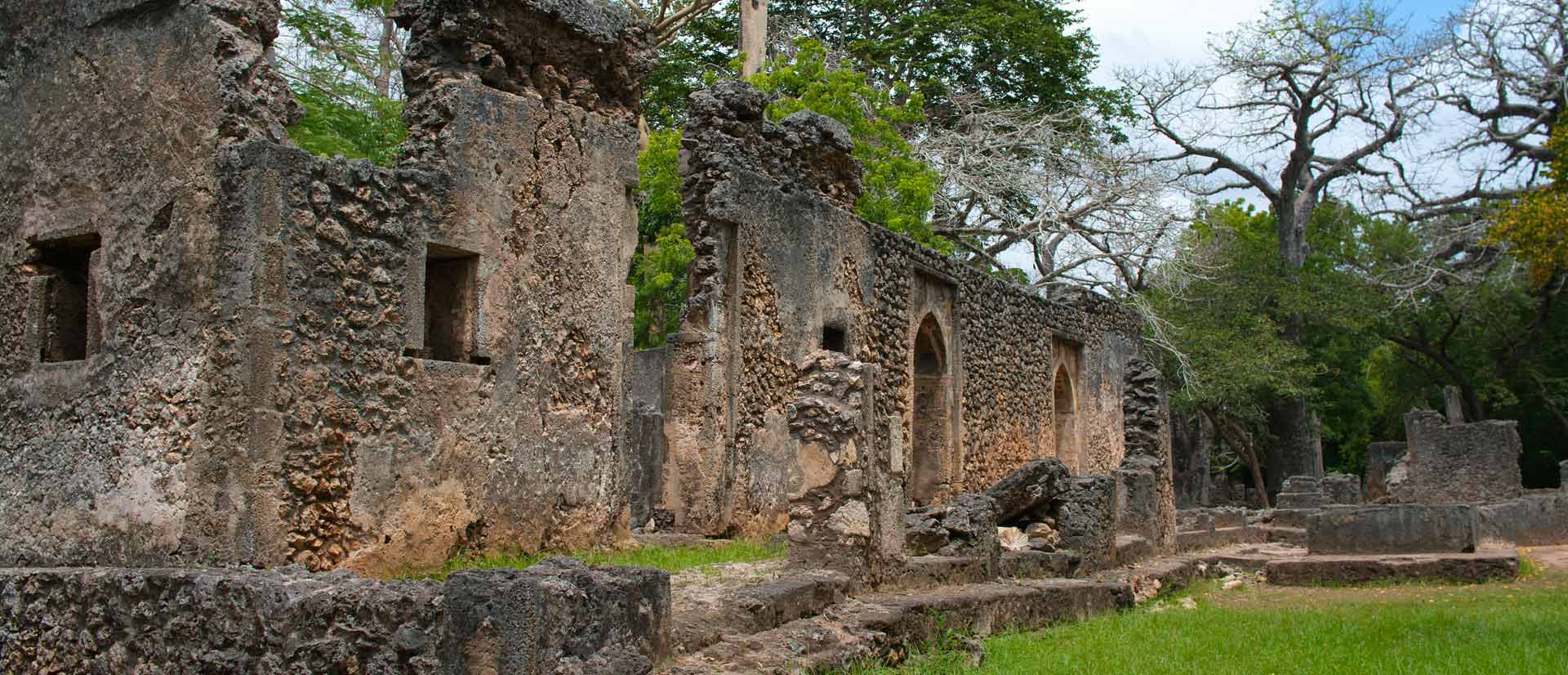
Recent archaeological discoveries
Archaeological research at Gedi and other coastal Swahili communities has become more intensive since the 1990s.The idea that Arab colonists or foreign influence via the Indian Ocean commerce drove the development of the Swahili Coast was challenged starting in the 1980s when archaeological study started to concentrate more on the connections between the coastal towns and the interior. The growing focus on the remnants of non-stone constructions is another significant advancement in the study of coastal Swahili sites. In Gedi’s wide terrain, surveys discovered extensive clusters of mud-thatched homes.
In order to study the urban development of the site, archaeologists from the National Museum of Kenya and Stephane Pradines of the Institute Francias d’Archeologie Orientale carried out a topographical survey of Gedi in 2001, mapping the spread of neighbourhoods. At the same time, Lynn Koplin surveyed the mud-thatch neighbourhoods, paying particular attention to the space between the inner and outer walls. In the years 2002–2003, Gedi study remained focused on the pre–fifteenth-century urban development, concentrating on a cluster of coral dwellings constructed in the urban centre of the site by members of the social elite.
The History of Gede Ruins
Excavations and historical records on its material culture, architecture, and the documented history of trade connecting the Swahili Coast with the areas bordering the Indian Ocean have led to the extrapolation of the history of occupation at Gedi. The first villages on the Swahili Coast appeared as trade picked up in the sixth century. The earliest evidence of human habitation at Gedi comes from a grave stone that was discovered and radiocarbon dated to between 1041 and 1278. This suggests that the site was probably occupied in the eleventh or early twelfth century.
Gedi’s inception and subsequent growth into an urban area with an estimated 2,500 residents at its height are thought to have been influenced by its involvement in trade. Even though Gedi isn’t mentioned in any historical records, it’s nonetheless regarded as one of the most significant coastal locations. The city first grew on the northern part of the current site before the outer wall was built in the fifteenth century. Three stacked mosques are evidence that the people there adopted Islam in the twelfth century. The mosques were built in the northern part of the city between the twelfth and the fourteenth centuries
It has been suggested that the Ibadite denomination had an influence on the locals because of the architectural style and lack of minarets found in all of Gedi’s mosques. Urban development at Gedi grew mainly to the north, west, and south from the eleventh through the fourteenth centuries, with the population eventually relocating around the Great Mosque in the fifteenth century. Gedi’s population and wealth peaked in the fifteenth and early sixteenth centuries, and in the late sixteenth and early seventeenth centuries, it started to collapse along with many other coastal sites. By the middle of the seventeenth century, Gedi had been abandoned.
Portuguese attempts to dominate trade and military operations during the sixteenth century have been considered major factors in Gedi’s final abandonment. However, Oromo migrations and raids from Somalia, the deepening of the well near the Great Mosque, a Wazimba attack along the coast in 1589, and the abandonment of Gedi and most of the mainland coastal sites north of Mombasa may have been due to a decline in the water table.