
Where to Hike in Tanzania other than Kilimanjaro : The majority of attention is drawn to the thousands of trekkers who take on the task of climbing Mount Kilimanjaro each year. Even if you don’t want to tackle that well-known summit, Tanzania provides incredible, lesser-known climbing and trekking possibilities that are all well worth donning your boots for. Tanzania provides a vast array of hiking and trekking options, from the top of a volcano to the bottom of a crater, for hikers of all ability levels. Here are a few of the best that we have selected. Keep in mind that before starting any walk in Tanzania, you must be in excellent physical shape. You should also pack enough water to stay hydrated in the hot, dry weather. Every excursion and hike should be accompanied by an armed ranger or guide. The Olmoti, Empakai, Ol Doinyo Lengai, and Mount Meru are among the craters in the Udzungwa Mountains.
Ngorongoro Crater
It is located 180 km (110 mi) west of Arusha City in the north-eastern Tanzanian region of the Crater Highlands, Ngorongoro Crater is part of the Ngorongoro Conservation Area, a protected area and UNESCO World Heritage Site. This place is a large volcanic crater known as Ngorongoro Crater. The Ngorongoro District of the Arusha Region forms the boundaries of the conservation area, which is administered by the Tanzanian government’s Ngorongoro Conservation Area Authority. The Great Migration, which takes place in the area that connects the two parks and Kenya’s Maasai Mara game reserve, sees millions of wildebeest, zebras, gazelles, and other species travel every year.The Serengeti National Park is bordered to the west of the park.The conservation area includes Olduvai Gorge, one of the world’s most important paleoanthropological sites.
The Ngorongoro Crater, the world’s biggest intact, empty, and inactive volcano crater, is the primary feature of the Ngorongoro Conservation Authority. The crater is 2,000 feet (610 meters) deep and spans 260 square kilometres (100 square miles). The structure was made when a massive volcano erupted and collapsed on itself, some two to three million years ago. The former volcano’s height is thought to have ranged from 4,500 to 5,800 meters (14,800 to 19,000 ft). Situated 1,800 meters (5,900 ft) above sea level lies the crater bottom. In February 2013, Seven Natural Wonders of Africa in Arusha, Tanzania, selected the crater as one of their Seven Natural Wonders of Africa. Volcanic activity occurred at the Ngorongoro volcano between 2.45 and 2 million years ago.
Empakai Crater
Half the enjoyment comes from the adventure of trekking down into the Empakai Crater, which is even deeper within the Ngorongoro Conservation Area. En route from Ngorongoro Crater, which takes two hours, you’ll see plenty of zebra, antelope, wildebeest, and other species. Alongside leading animals through remote, wild areas will be locals. The crater walls frame Empakai Lake, which is located far below, making for a spectacular spectacle on clear days, even though clouds periodically obstruct the view from the rim of Empakai, which is 9,000 feet (2,743 meters) high. You swiftly descend to the lake through a forest full of songbirds, and around twenty-five minutes pass. Occasionally you can see tracks on the sandy trail, which belong to some of the enormous cats that live there. Blacksmith lapwings, flamingos, and other species are likely visible along the salt-crusted lake’s edges. The journey back up to the crater rim is more strenuous in the warmest periods of the day and can take up to an hour.
Ol Donyo Lengai Volcano
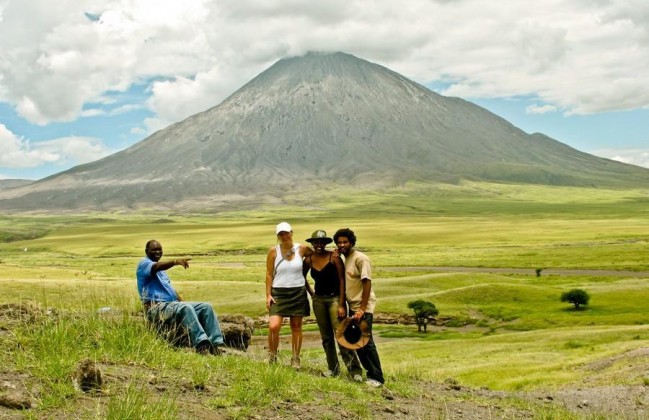
It is not a challenge for the faint of heart to climb the Lengai Volcano. The still-active volcano is called the “Mountain of God” because the natives thought the internal rumbling was the voice of God. It is reachable from camping around the edge of Lake Natron. Verify with your guide the night before whether there is a good chance of clear skies in the morning by looking at the weather and cloud cover. Usually starting at midnight, the objective is to reach the summit in time to see a spectacular sunrise, using headlamps to aid the ascent. The hike is a demanding five to six hours that goes almost entirely uphill on a track that is periodically deep in sand and occasionally covered in jagged rock.
Udzungwa Mountains National park
The southern Tanzanian park known as Udzungwa Mountains National Park, or “the Galapagos of Africa,” is home to a variety of tropical flora and protected species, including African wild dogs, elephants, lions, leopards, and primates, including the critically endangered Iringa red colobus monkey. It is also a well-liked trekking destination, with pathways scattered across the vast national park. The routes span a variety of lengths, from easy strolls to challenging climbs up Mwanihana Peak. The 40-mile (64-kilometer) Lumemo track is the longest and takes about five days to finish. A walk of 23 miles (37 kilometres) over one or two nights is an additional option. The most popular journey is the two to three-hour hike to Sanje Waterfall, which features a stunning 600-foot (183-meter) waterfall. Along with the waterfalls and cool pools at the end of their hike, hikers can see endemic Sanje Crested Mangabey monkeys, red duiker and squirrels.
Olmoti Crater
Olmoti Crater, home to a multitude of animals, is only an hour’s drive from one of the best places on Earth to view the “Big 5” wildlife encounters: lion, leopard, rhinoceros, elephant, and buffalo. Very few visitors to the crater, nevertheless, venture further into the Ngorongoro Conservation Area to view the other volcanic panoramas. Olmoti leads into an ancient caldera and is a pleasant, quick trek. Hike steadily for around forty minutes to reach an elevation of 9,800 feet (2,987 meters), from where you may see a panorama of the beautiful river valley below. Even while there isn’t as much wildlife as in the Ngorongoro Crater, you can possibly still see wildebeest and zebra grazing in the distance. The trail ends above the Olmoti waterfall, but you can carry on walking with your armed ranger across the grassy plains of the caldera, signalling to any sleeping buffaloes or lions that you are approaching.
Mahale Mountains
The gorgeous Lake Tanganyika, with its turquoise waters and fine sand beaches that make for excellent snorkelling, is reached by the verdant Mahale Mountains in Tanzania’s remote west. This is one of the best places to see chimpanzees, our closest cousins. I think the best way to see wildlife on Earth is to get up close and personal with these acclimatised chimpanzees in their natural environment. It’s even better than seeing mountain gorillas, actually. Walking briskly is probably required to keep up with the chimps because they traverse huge distances.
Mount Meru
Mount Meru is Tanzania’s second-highest peak, rising to a height of 14,980 feet (4566 meters). Not only is hiking an amazing experience in and of itself, but it’s also an excellent way to acclimatise yourself before climbing Mount Kilimanjaro. Mount Meru is a strenuous climb that is best completed in three to four days. It is located in the Arusha National Park, about 50 miles (80 km) west of Kili. Lower on the surrounding hills, giraffes, elephants, buffalo, and warthogs are frequently spotted; the more elevation you ascend, the more impressive are the volcanic vistas. There are mountain cabins along the trail that offer lodging. Reaching the summit at daybreak offers amazing views of the Mount Meru Crater and Mount Kilimanjaro.