
What to Pack for a Photo Safari in Tanzania?
Do you want the best safari shots? Embark on a Tanzania safari where every capture is epic, where your camera is your faithful companion throughout the game drive. We’ve seen people bring the wrong equipment and others pack too many things, which, in the end, aren’t needed. In this guide, we describe what you can pack for your wildlife photography tour.
A photo safari is an adventure with two primary goals: observe and shoot. This safari suits everyone, from avid photographers and filmmakers to social media content creators and digital marketers. You need calmness, mindfulness, and focus. And for such a reason, we recommend hiring a private vehicle with an expert field guide.
So, what do I pack for a photo tour in Tanzania?
To be honest, there’s no such thing as the perfect list for every photographer. Tanzania is big, with so many wonders to explore. For instance, if you’re going to photograph on Mount Kilimanjaro, include Kilimanjaro climbing gear in your list.
If you plan to capture the vibrant marine species in Zanzibar, add scuba diving or snorkeling gear and waterproof equipment to the list. But for a general Tanzania photography safari, we’ve categorized the list into essentials, safari clothing, recommended gear, and other items.
The Essentials.
Your primary target is to capture wildlife, landscapes, and maybe people. You need a camera (a good one), a lens, and other accessories. Always pick the right essentials that will offer the best photographic experience. Let’s see them down below.
Cameras
As said, a camera is your good friend in Tanzania. What quality? You decide based on what you want to photograph. We all know how fast wildlife moments are. That in the blink of an eye, a cheetah passes in front of you chasing its prey at the fastest speed ever. So, you need the best camera to capture such a moment. Here’s what to consider.
- Frame rate—This is the number of shots your camera can take in a second. The cheetah case above requires higher frame rates of 5 and 40 fps.
- Resolution—Higher resolution is perfect for the best shots. However, we recommend you balance between frame rate and resolution.
- Buffer size—That’s the number of shots your camera can take without freezing. That’s crucial when photographing a kill or a river crossing, or anything that may take more than 10 minutes.
Here are our recommendations:
- Sony a1.
- Canon EOS R1, R3, R5, & R6 II.
- Sony A7R V.
- Sony A9 series.
- Nikon Z9
Insight: Bring two cameras; if things go south, you have a backup plan. Though this rarely happens, make sure your cameras are complementary. That means you can replace a failed battery from one camera to another. For example, Fujifilm has complementary pairs: Fujifilm X-H2 and X-H2S, while Nikon has Nikon Z7 II and Z6 II.
Lenses.
Wildlife photography is not like other types of photography. You don’t have to get so close to wildlife. Having a good lens that can zoom distant animals is key. Here’s what to consider:
- A long focal length, at least 200 mm. This will enable you to capture distant animals like a leopard lounging in an acacia. You will also be able to focus on small birds like
- A wide aperture (an f/1.8 aperture). This allows more light to enter the lens. As a result, you can focus on objects in low light, like during morning and late evening drives.
Our recommendations include:
- Nikon Z 24-120mm f/4 S lens.
- Sony 400mm f/2.8 GM.
- Nikon Z 100-400mm f/4.5-5.6 VR S
- Canon RF 100-500mm f/4.5-7.1 L IS USM
- Sigma 150-600mm Contemporary or Sports
Batteries and Chargers
As a seasoned photographer, you need at least 2 to 3 spare batteries in your bag. Wildlife photography is a game of waiting. Sometimes, you have to take many shots, which may drain your battery. Change the battery early, before your camera goes off, to avoid missing out on a crucial moment.
While at the camp or lodge, we recommend you recharge your batteries to ensure they are fully charged. If necessary, you can bring chargers that charge multiple batteries at a time.
Filters, Memory Cards, and Storage.
Even though wild pictures are good in their rawness, sometimes you may need filters to make them look perfect. Also, make sure you have enough memory cards and storage devices like SSD drives.
Other items.
- Flash
- Rain and dust protection
- Tripods and tripod heads
- Audio recorder
- Cleaning kit
Safari Clothing for a Photo Tour
As a rule of thumb, safari clothing is always simple. You don’t have to bring so many things to overpack your luggage. Make it simple. Here’s our recommended list.
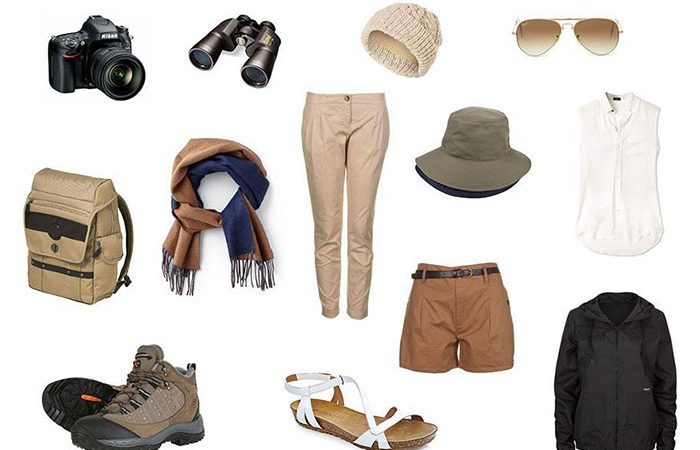
What to Pack for a Photo Safari in Tanzania? Long-sleeved shirts and pants. Protect yourself from insect bites.
- Wide-brimmed hat: it’s sunny out there.
- Fleece or a light jacket for morning and late drives.
- Waterproof jacket: occasional showers may happen.
Insight: Choose neutral colors like khaki, olive, or brown. Avoid black and dark blue, as you get many bites from tse-tse flies.
Other Gear
Binoculars—There are those moments you’ll need binoculars or monoculars. For example, when scanning for wildlife movement, it may be impractical to do that with your camera.
Computer or Tablet—You need any of these gadgets to back up your photos. We recommend you bring small, portable ones to avoid overpacking.
The bottom line
And we are always by your side. You can trust us. We’ve taken many clients through the Serengeti, Ngorongoro Crater, and to hidden gems like Nyerere and Ruaha. Call our experts to start planning your next photographic safari.