
Top 5 facts About Mountain gorillas : One of the most exciting animals in the world, mountain gorillas are particularly common in several national parks in Africa, including the Virunga Mountains in the Congo and the Bwindi Impenetrable Forest in Uganda. The big wildebeest migrations in the Serengeti National Park and mountain gorilla climbing in Uganda and Rwanda make every safari in Africa even more interesting and pleasurable.
Every day, individuals eager to begin their gorilla trek as part of the Uganda gorilla trekking safari gather at the briefing area in the various sectors of Bwindi Impenetrable National Park. To get a close look at mountain gorillas and learn more about them, they head out into the dense Bwindi Forest and Mgahinga Gorilla National Park rainforests. The largest population of mountain gorillas is found in Bwindi Impenetrable National Park, with the remaining populations spread throughout Mgahinga Gorilla National Park in Uganda, Volcanoes National Park in Rwanda, and Virunga National Park in the Democratic Republic of the Congo. Here are 5 facts about mountain gorillas that you should be aware of before you go gorilla trekking safari in any of the parks.
1. Mountain gorillas are social beings.
Mountain gorillas live in groups of six to thirty gorillas, each headed by a male named Silverback, much like humans. The male gorilla reaches adulthood when it is around 13 years old and begins to develop a silver hue. The Silverback’s responsibilities include planning the troop’s excursions and downtime, bearing the majority of the young, and protecting its members, primarily the females. The family is often made up of newborns, adult females, younger female gorillas, and younger male gorillas.
2. Mountain gorillas have descriptive names.
The mountain gorilla scientific name is officially known as Gorilla Beringei-Beringei. The Mountain Gorillas’ chosen moniker, however, quite nearly describes the mountainous environment in which they thrive. They reside in the high tropical Bwindi Forest and Virunga Ranges at heights between 1,500 and 4000 meters. The foliage is thick and plentiful, and the temperatures are cool enough to support the gorilla’s vegan diet. The male mountain gorilla’s back develops a silver stripe, which is why the name “Silver Back” was chosen to describe it. It would be sufficient to state that it resembles the gray hair that people grow as they get older.
3. They are nomadic animals.
Do not mistake mountain gorillas for the lowland gorillas that are frequently found in zoos; they are not territorial and could not survive life in a zoo for very long. Depending on the location and availability of food, they are constantly moving. To see them, you must travel there and embark on a gorilla trek, which entails traveling through the Bwindi Impenetrable Forest and up the slopes of the Virunga volcanoes. The Silverback makes the daily decisions regarding when and where to move.
4. Mountain Gorillas are vegan.
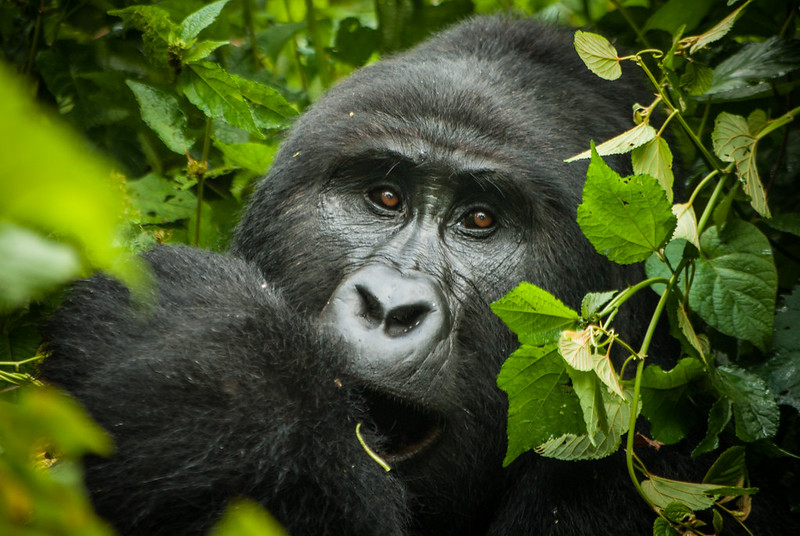
An adult mountain gorilla’s daily diet consists of leaves, shoots, wild fruits, and flowers. Mountain gorillas thrive in mountainous regions and woods, which may be explained by the fact that their environment has dense flora to support their diet. Contrarily, the little ones do well on breast milk up until the age of three, when they start eating vegetarian like the rest of the family.
5. Mountain gorillas are an endangered species.
Mountain gorillas were listed as an endangered species by the IUCN. An influx of people settled in the gorillas’ potential habitats as a result of the political unrest in the DRC and Rwanda. Gorillas were persecuted, and people frequently entered their habitats to burn charcoal or practice agriculture. Additionally, they are susceptible to human illnesses like colds, which they can readily contract only with greater gravity. They may even pass away from a simple cold. It is therefore advised to avoid trekking if you have the flu or a cold in order to stop the spread of these illnesses.
Conclusion: Make a gorilla trekking vacation to Uganda, Rwanda, and Congo your next African adventure instead of the great wildebeest migrations in the Maasai Mara and Serengeti national parks and the Big Five safaris in Ngorongoro conservation area. You will have an experience that you will never forget because it is both pleasurable and once in a lifetime to come face to face with these gentle giants in the forested mountains. To arrange your upcoming gorilla trekking safari vacation to east Africa, get in touch with Focus East Africa Tours. We can promise you the best safari experience you’ve ever had.