
Top 10+ Things To See And Do In Dodoma, Tanzania: Tanzania’s official political capital and seat of government is Dodoma, which is situated in the nation’s interior. It is considerably smaller and less developed than Dar es Salaam, the nation’s commercial hub.
Dodoma continues to serve as a hub for national politics. The city of Dodoma, which is located on the eastern edge of the southern highlands, is surrounded by a flourishing agricultural region and beautiful scenery. Dodoma offers a wide variety of attractions for passing travelers. It serves as the hub of Tanzania’s expanding wine industry, and Tanganyika Vineyards Company actively markets its goods there.
In the past, Dodoma served as a rest stop for caravans traveling from the Swahili Coast inland toward Lake Tanganyika. The city rose to prominence on the Central Line railway early in the 20th century as it transported agricultural products for export to the Dar es Salaam harbor.
The town’s economic foundation has recently shifted away from the coastal city, but during Tanzania’s early days of independence, there was a widely supported political motion to relocate the entire government to the town in the southern highlands. The government legislature currently meets in Dodoma and splits its time between the inland city and the coastal city of Dar es Salaam.
THINGS TO SEE AND DO IN DODOMA, TANZANIA
Most tourists probably associate Tanzania with the pristine beaches of Zanzibar, the Ngorongoro Crater, and the roaming lions in Serengeti National Park. The capital city of the nation, Dodoma, is frequently blatantly disregarded or even confused with the previous one, Dar es Salaam, which lost its title in 1974.
It’s pointless to blame travelers for avoiding Dodoma, but surprisingly, if you choose to travel to the Tanzanian interior, this anonymous capital city has both cultural and natural wonders worth exploring. Seven of the city’s most intriguing tourist attractions are compiled here.
THINGS TO SEE AND DO IN DODOMA: FOR THE EXPLORER AND SITE SEEKER IN DODOMA
Simba Hill
The city’s most recognizable landmark, also known as Lion Rock, is a hilly formation topped by a few protruding boulders that can be seen as a backdrop from almost anywhere in the city. Simba Hill is a fantastic choice for a half-day hiking trip because, despite being on the outskirts of Dodoma’s city center, it is quickly and affordably reachable by Dala-Dala minibus service.
It takes about three hours to reach the top, and depending on how you ascend, you might see the prime minister’s house, which blends remarkably well into its rocky surroundings. Unquestionably laborious, this arduous hike is rewarded by breathtaking views of Dodoma and its neighboring villages that resemble those of a lion king.
Bunge-Parliament complex
After many African countries gained their independence in the 1960s, some of them made the decision to relocate their capitals inland, away from the coastal cities, to a more neutral region that was unaffiliated with any local tribe or colonial power. Following suit, Tanzania moved its capital from Dar es Salaam to Dodoma in 1974. At the time, Dodoma was a remote village perched at a long-gone intersection between the coastal region and Lake Tanganyika.
After years of delays and logistical challenges, the National Assembly and other governmental buildings were finally completed in 2006 and officially opened as the Parliament Complex. This building’s appeal is found in its simplicity and lack of cultural allusions, reflecting unapologetically the emergence of a brand-new nation that is in control of its own destiny.
The national assembly is only accessible to the public during sessions, but it is clearly visible from the outside. Please note that taking photographs inside the National Assembly without permission is strictly prohibited and may result in penalties.
The Anglican Cathedral
The majority of people in sub-Saharan Africa have adopted Christianity, which is one of the most important imprints left by European and African contact over the past two centuries. Following waves of missionary activity, Tanzania, a former British colony, developed a vibrant and diverse Christian community that is split almost evenly between Catholics and Protestants.
Only 20% of Protestants identify as Anglicans, but despite their relatively small number, this community is clearly flourishing, as evidenced in part by the magnificent cathedral that towers over central Dodoma. Middle-Eastern and Ethiopian Christian architecture can be seen in the cathedral’s main octagonal structure, which is made of unpolished stone bricks and is topped with a tiled dome.
Gadhafi Mosque
The Gadhafi Mosque, which bears the name of the late Libyan dictator who oversaw the majority of its construction, is by far the biggest mosque in Tanzania and the second largest in all of East Africa, trailing only the Gadhafi Mosque in Kampala, Uganda.
The mosque is the largest religious structure in Dodoma, with a capacity of 3000–4000 worshipers. Its splendor is at its height on Fridays, when it serves as an unofficial entrance to the capital. Its proximity to the airport further emphasizes its significance.
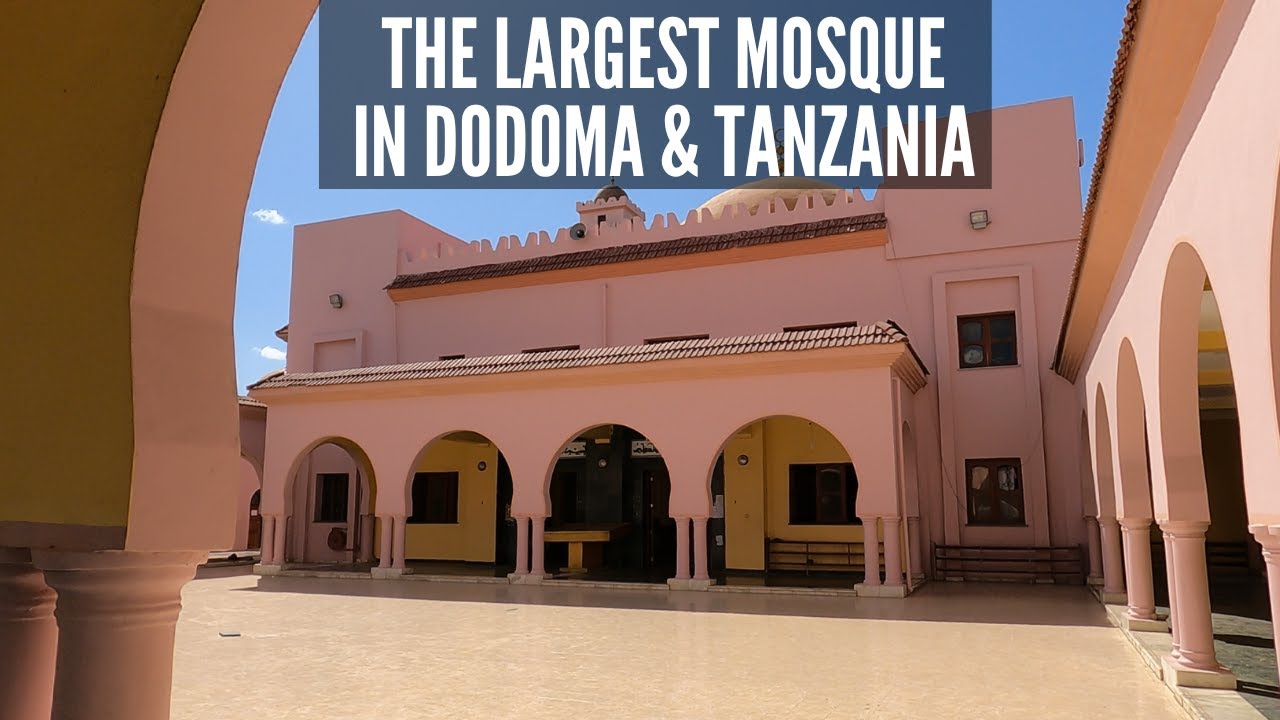
The mosque’s architecture is relatively simple and devoid of ornamentation, focusing almost entirely on creating a comfortable space for worshipers. This is partially reflected by a colonnade that shields worshipers from the intense African sun and a large entrance plaza that serves as a gathering place during religious holidays.
Nyerere Square
The most significant public space in Dodoma, Julius Nyerere Square, which bears the name of the modern Tanzanian founder, pays tribute to a national and continental hero who peacefully liberated his country. Nyerere is still revered in Tanzania despite his contentious political career and disastrous economic policies, as evidenced by the neatly kept square that is dominated by a statue of him holding his renowned ebony stick as a sign of authority.
Nyerere Square is a multi-purpose plaza that includes a decent and pleasant garden as well as a casual hawkers market selling local goods and souvenirs, in addition to drawing tourists and residents alike because of its importance.
Kondoa Irangi Rock Paintings
Most outsiders have an image of primitive tribalism in Africa that includes endless grasslands and coexists with wildlife. While this is rarely the case today, one such hunter-gatherer tribe, the Sandawe people, still exists and thrives in the area around Dodoma.
The only evidence of the pre-modern existence of the Sandawe tribe is a collection of rock paintings that can be found near the town of Kondoa, about 150 kilometers north of Dodoma. Written language and any long-standing architectural structures are also nonexistent.
The Kondoa Irangi Paintings, which are about 1,600 in number and dispersed across 200 different locations and are listed by UNSCO as a world heritage site, feature elongated human figures, wild animals like elands and giraffes, as well as haunting scenes.
Irangi Hills, located close to Kolo Village and three hours’ drive from Dodoma, is the most well-known and easily accessible location. While driving to the Kondoa Irangi Paintings is an option, booking a partially organized trip through one of Dodoma’s many travel agencies is the safest and easiest way to travel there.
THINGS TO SEE AND DO IN DODOMA: FOR THE FOODIE IN DODOMA
Leone L’Africano
In the shadow of Lion Rock, enjoy a hearty meal of delicious Italian cuisine, including one of Tanzania’s best pizzas. You can also pick from a variety of regional wines or take the safe route with a vintage from Europe. A 12-hole mini-golf course and a playground are also included.
The New Dodoma Hotel
Pizza, fish and chips, dhal tadka, and fajitas are among the options on the menu that are influenced by a few international influencers. The most well-liked cuisines are Indian and regional, and for dinner, the outdoor Barbeque Village grills a variety of meats. The hotel’s Chinese-owned restaurant, which is also noteworthy, is a roulette wheel when it comes to ordering because the food can be either excellent or appalling.
Dodoma Wimpy
Although it isn’t a true Wimpy in the sense of the well-known franchise, it does offer you a staple in the form of greasy burgers along with the usual selection of regional dishes and snacks, the majority of which are of Indian origin, such as bhaji and chicken biryani.
Aladdin’s Cave
Check out Dodoma’s recreation of a vintage candy shop and soda fountain if you have a sweet tooth and simply have to have something to sate your cravings. For some reason, they also decided to offer veggie burgers and pizza, which could be quite the complement to all those sweet treats before or after.
KRose’s Café
This location is a must if you’re looking for a taste of East Africa. They have a wide selection of excellent Indian dishes, and the prices are very reasonable. The vegetarian thali seems to be a common option among customers if you’re having trouble choosing what to order.
Veta
In the area, Veta is renowned for both its excellent cuisine and its notably slow service. Be patient as your food is delivered because, unless you happen to be there when Parliament is in session, your options may be limited. Veta’s most appealing feature would be its affordable prices.
THINGS TO SEE AND DO IN DODOMA: FOR THE SHOPAHOLIC IN DODOMA
Shabibi Supermarket
Shabibi supermarket is one of the few options available if you need to restock on supplies in the town of Dodoma, which is not very well stocked with options. When traveling to Dar es Salaam from the city center, you will encounter a small supermarket on the second floor of the Shabibi gas station at the second roundabout.
Yashna’s Supermarket
Yashna’s Supermarket is situated at the Gapco gas station, close to the central roundabout. The largest store in the center (which does not mean much) offers pasta, canned vegetables, chocolates, cookies, frozen cheese, ground coffee, and some cosmetics, but don’t get your hopes up if you’re looking for a wide variety of products.
Two Sisters
Can be found on Hatibu Avenue (in the pink Zain building, close to the main roundabout). Two Sisters is the place to go if you want something homemade and fresh. You can buy a variety of cheeses, dark bread rolls (occasionally), homemade yogurt, frozen foods, canned goods, pasta, wine, candies, crisps, and snacks from Indian cuisine. You’ll be welcomed by extremely welcoming and helpful staff, as is the case throughout most of the city.