Tips for mountain gorilla trekking: “These crucial gorilla trekking suggestions will enable you to make the most of this unforgettable wildlife adventure” The mountain gorilla, an endangered subspecies of the eastern gorilla found nowhere else on Earth, has seen a remarkable resurgence. One of Africa’s biggest conservation success stories is the result of a succession of conservation initiatives that included the local community. More than 1,000 mountain gorillas now wander the mountains of Uganda, Rwanda, and the Democratic Republic of the Congo, up from about 480 in 2010. Despite still being listed as endangered.
Over half of them live in the Virunga Mountains, an array of eight dormant volcanoes that straddles the boundaries of southern Uganda, Rwanda, and the Democratic Republic of the Congo. The remaining animals are located in Uganda’s Bwindi Impenetrable National Park, a veil of tangled green that encompasses the nation’s southwest mountains. A trip excursion known as “mountain gorilla trekking“ will take you to the Ugandan mountains of Bwindi, Volcanoes, and Virunga. Compared to a regular safari, this gorilla trekking sport requires more effort, more time, and more money. Here is all the information you need to know about mountain gorilla trekking in Rwanda, Democratic Republic of the Congo and Uganda.

Gorilla trekking tips
Focus East Africa Tours has over 5 years of expertise leading gorilla safaris in the area, so they are highly knowledgeable about getting close to these magnificent animals. We have put together the following gorilla trekking advice to help you plan and have unforgettable safari experience.
WHERE CAN YOU SEE MOUNTAIN GORILLAS?
There are now just two mountain gorilla populations left in the world. The first is found in the Virunga volcanic highlands of Central Africa, and there are groupings of them in Uganda, Rwanda, and the Democratic Republic of the Congo (our trips take you to the Bwindi Impenetrable Forest in Uganda and the Volcanoes National Park in Rwanda).
The second group resides deep in Bwindi Forest. The best estimates, as of last year, place the number of mountain gorillas in the wild at less than 900. As a result, they are listed as critically endangered (two classifications away from being completely extinct).
MOUNTAIN GORILLA TREKKING AT ITS FINEST
The first thing to understand is that embarking on a group excursion to see mountain gorillas or go mountain trekking can be rather pricey (going solo is often even more so). The logistics of visiting gorillas are difficult enough because these animals live in isolated regions and in nations with weak tourist infrastructure. For skilled guides to conduct tour groups into Virunga, Bwindi, or Volcanoes National Parks, permits must also be purchased.
We have yet to hear of anyone returning from a gorilla visit unimpressed, but it’s just something to keep in mind. The experience, like most game drives in Africa, is entirely worthwhile. It’s also important to keep in mind that Ugandan gorilla treks have seasonal permit pricing, meaning that permits are almost half as expensive in March and April.
THE GORILLAS COME FIRST
Natural behavior can be altered and negatively impacted by human contact with wildlife. As a result, each trekker’s top priority should be to ensure the safety of the gorillas. It’s crucial to realize how crucial it is to leave gorillas alone and unharmed, especially when reproducing, and to refrain from destroying or altering their habitats. For the safety of you and gorillas the guidelines listed below should be used when around gorillas.
- Never approach the gorillas closer than 7 meters (21 feet).
- If they come, move away quietly and gently.
- Don’t trek if you’re sick, and cover your mouth if you sneeze or cough. Gorillas have 98% of our DNA, making them particularly vulnerable to sickness.
- To avoid encircling or frightening gorillas, stick together.
- Avoid making eye contact with the gorillas because it may frighten them and make them hostile.
- Reduce your voice volume.
- Never spend more than an hour with a gorilla group.
- Always follow your guide’s instructions; they are the group’s subject matter experts, Tips for mountain gorilla trekking
- Follow the fundamental guidelines of the Leave No Trace code of conduct.
DON’T FORGET TO OBTAIN A PERMIT BEFORE YOU LEAVE ON YOUR GORILLA TREKKING SAFARI.
One of the most crucial things to keep in mind while organizing a gorilla trekking safari is that you need a permit to observe gorillas in both Rwanda’s and Uganda’s national parks:
- Rwanda’s Volcanoes National Park costs US $1,500.
- Uganda’s Bwindi Impenetrable Forest costs US $601.
Because there are restrictions on how many individuals can enter the parks, these gorilla trekking permits are challenging to obtain. These licenses will be acquired on your behalf by Focus East Africa Tours, and the price of your gorilla trekking expedition includes them. The most important thing in this situation is to organize your gorilla trekking expedition well in advance.
VISIT IN THE DRY SEASON
Although you may go gorilla trekking all year round, the ideal time to go is in the dry season. All around the nation, the weather is more pleasant for hiking and normally makes it easier to see wildlife. Additionally, it implies that jungle areas are easier to access because tracks and trails are easier to navigate and roads are less prone to flooding.
The two best dry seasons in Uganda are from December to February and June to August. In a similar vein, the dry season, which runs from June to September, is the ideal time to visit Rwanda and go gorilla trekking.
MOUNTAIN GORILLA HABITAT
Mountain gorillas inhabit cloud forests at elevations between 2200 and 4300 meters (a not insignificant height – you may feel a little short of breath. Remember to let your guide know if you feel a headache coming on).
The lower slopes will have dense vegetation, frequently made up of a mixture of bamboo, ferns, and gallium vines. The undergrowth ought to get a little less dense as you ascend. The gorillas’ habitat is foggy, wet, and occasionally freezing (depending on the climate). Mountain gorillas migrate according to the season, staying in the subalpine areas during specific times of the year to eat senecio trees, Tips for mountain gorilla trekking
BE TIMEOUS/PATIENT
As with any wildlife watching, patience is key. There is no guarantee of sightings, and wild animals frequently do as they please. A gorilla can’t be asked to wait in a clearing, turn to face the camera, or stand in better lighting, sadly.
Finding the gorillas can occasionally take longer than expected, and you may not be able to spend as much time with them as you would like. This might be advantageous to you or them. Being in the right place at the right moment is the only way to succeed. Even if it may occasionally take longer, the time will always be well spent.
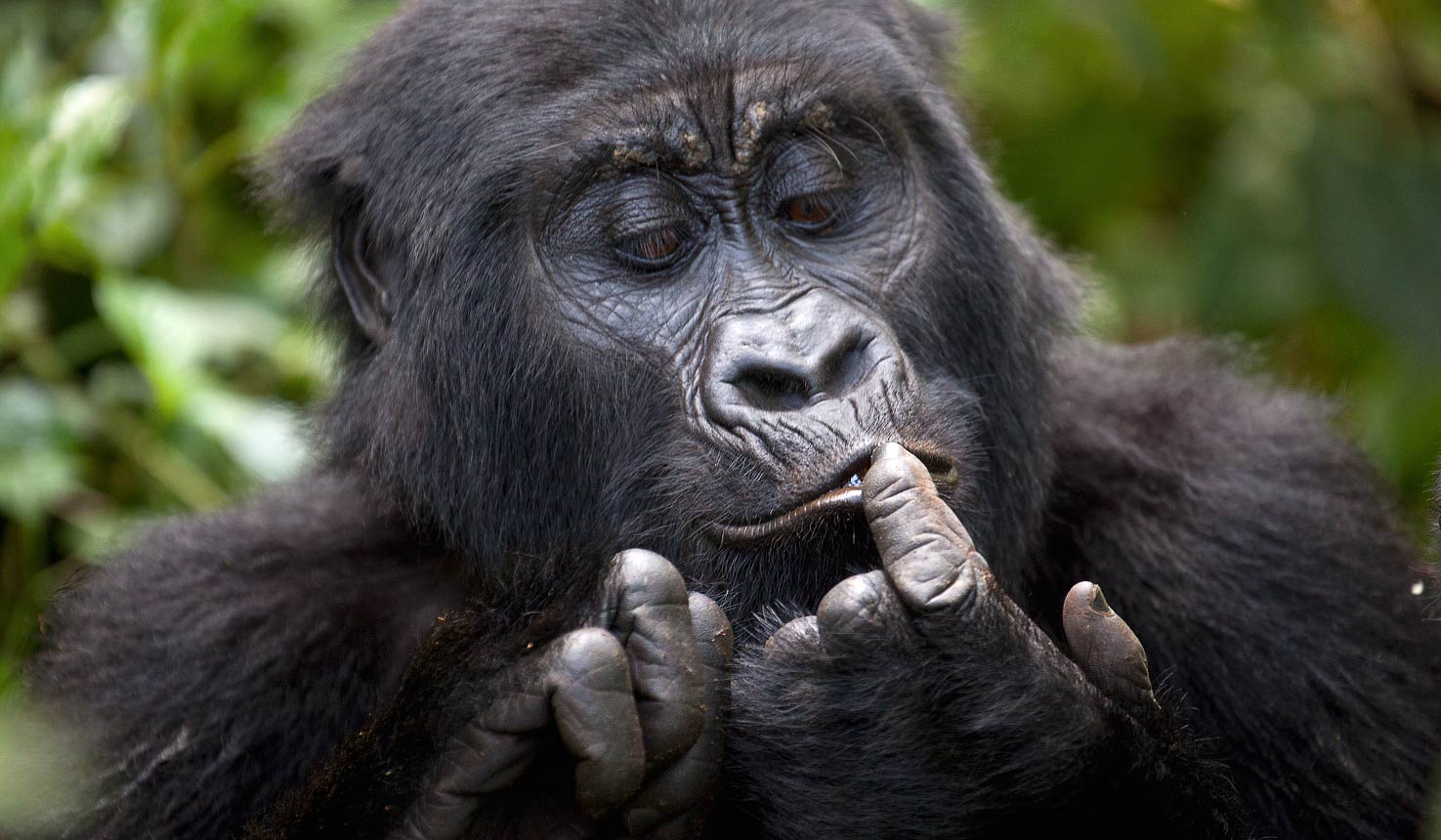
THERE’S MORE TO SEE THAN JUST GORILLAS
Even if you don’t see gorillas, Uganda and Rwanda are both worthwhile vacation spots in their own right. These two small but beautiful nations may represent the best of the continent.
The Rwenzori, often called the “Mountains of the Moon,” are the highest mountain range in Africa and are located in Uganda. Trekking on the higher, glaciated, permanently snow-capped hills is difficult but extremely rewarding. The highlands are the source of the Nile, which is where some of the most exhilarating white water rafting in the world can be found.
Other attractions include Lake Bunyonyi, one of the most impressive waterfalls in the world, Murchison Falls, and a number of national parks that are home to a variety of fascinating species, including Africa’s big five game animals—the lion, leopard, rhino, elephant, and buffalo.
PACKING LIST: WHAT TO PACK FOR GORILLA TREKKING
Hiking Boots are a must: You’ll do well to invest in an excellent pair of hiking boots from a retailer like Kathmandu. Although they are pricey, so are your ankles when they fracture. Don’t take a chance with a cheap pair of sneakers, Tips for mountain gorilla trekking
Gloves: If you’re not careful, your hands could get scratched and basically beaten up when you’re on a walk gripping trees, branches, and vines. Bring some sturdy, used gardening gloves. You’ll be happy you brought them, even if they’ll look stupid.
Lightweight raincoat: Both Bwindi and Virunga are tropical rainforests with a nearly constant likelihood of rain. Bring along a lightweight raincoat or poncho that you can roll up in your backpack and pull out as needed.
Energy bites: Although possible, the trek to the mountain gorillas is challenging. It’s a good idea to eat energy snacks like almonds, dried fruit, chocolate, or power bars. Just remember to take any trash you may have with you.
Water: While visiting Rwanda or Uganda, avoid purchasing plastic water bottles. They harm the ecosystem greatly. Bring a pack of filtration tablets or a reusable canteen with a built-in purifying filter. Throughout the walk, you’ll need to drink a lot.
Shirts and long pants: During the jungle walk, it’s advisable to avoid showing too much skin. Also, don’t forget to tuck your pants into your socks since you don’t want safari ants creeping up there.
WHAT SHOULD YOU EXPECT ON A GORILLA TREK?
Your guides meet you at park headquarters the morning of your walk and go over the guidelines for trekking with mountain gorillas. These include how to act around mountain gorillas and maintaining a safe distance from them, Tips for mountain gorilla trekking
There will be various trackers and guides for you. Some members of your group will stick with you, guiding you to the location where your mountain gorilla family was last spotted. Others will continue on, looking for where the family is right now. Any significant information will be radioed to your group.
You’ll deviate from the beaten path since the ground is uneven. Use the walking stick that came with your permission. Hiring at least one porter is something we strongly advise. Porters can help you go across challenging terrain and carry your belongings. They facilitate your journey and offer a wealth of knowledge when you converse with them. Additionally, you will support a vital source of local revenue.
One to six hours may be needed to locate a family of mountain gorillas. Rarely do gorilla trekkers lose sight of their troop after a while. In the years we have been providing gorilla treks, we have never had a customer miss seeing gorillas. An element of the charm of a gorilla trip is the pursuit. You might have the opportunity to admire the forest surroundings. Enjoy the trip, refuel with snacks, and ask your guides any questions that catch your attention, Tips for mountain gorilla trekking
You quickly forget about any exhaustion from the trip once you arrive at your mountain gorilla family. Due to its infinite mountains, Rwanda is known as the “Land of a Thousand Hills,” yet it also has a lot to offer to visitors. Beyond the Virunga Mountains, Rwanda is home to some of Africa’s most beautiful interior beaches along Lake Kivu, and the extraordinarily biodiverse Nyungwe Forest National Park allows visitors to search for chimpanzees.