
Tanzania Boma Natural Museum : Everything To Know : The Boma Natural History Museum is a complex that displays the natural history, wildlife, culture, and artifacts of the Arusha region in Norther Tanzania Safari circuit. It has three separate buildings that are open to the public (the rest are offices), a small outdoor botanical garden, and an outdoor gallery for arts and crafts. It is located inside what was once an old German military outpost.
One of the three buildings is dedicated to wildlife, the other to regional history, and the third to archaeological history. Apart from the Boma Natural History Museum, Tanzania’s other national museums include the Dar es Salaam Museum, the Sukuma Museum, the Mwalimu Nyerere Museum, and the Makumbusho Village Museum. The following are some of the items on display at the Boma Natural History Museum:
- Artifacts from excavations in neighboring areas such as Olduvai Gorge and other dead wildlife
- A history of the region of Arusha and its people
- A wildlife section with photographs and taxidermy
- An arts gallery that displays the work of over 12 of the best local artists
- Art and crafts lessons from locals, including painting, drum making, etc.
- A mini botanical garden
- A small pond with some of the local freshwater fish
- A mini-zoo with some of the region’s rare animals, such as an eagle
- A section on insects details some of the diseases and problems they cause.
- A taxidermy office
- Photography of some of the local tribes
THE BOMA NATURAL MUSEUM: HISTORY OF THE PLACE
In order to serve as a German military outpost for the Arusha region, the Original Boma was constructed between 1899 and 1900. This was done in order to keep a closer eye on the tribes of Meru and Arusha, whose opposition they had just vanquished in the years 1897 and 1898. Other colonial officials used it as both a residence and an administrative office.
The defeated warriors had to work at least seven hours a day to construct the fort, using their spears to dig out stone and their shields to transport it there. The elderly had to make the mortar for joining the stones out of wet mud, while the women and children of the tribe were required to bring banana fiber for thatching.
The finished building was a walled, rectangular compound surrounded by a barbed wire fence and a trench that was about 6 feet deep. There were several buildings inside the compound, and there was a kitchen garden and coffee plantation next to it.
As the first modern building in the area and a security stronghold, it attracted more people looking for work and business opportunities. Following World War I, when the British took control from the Germans, the fortification was still in use, with government officials using the front two buildings.
It was transformed into a natural history museum in 1979 by Tanzania’s independent government. Since then, several sections have been added, including a small aquarium, a mini-botanical garden, a gallery for local artists, a history and artifacts section, a wildlife section, and an arts gallery that also offers lessons.
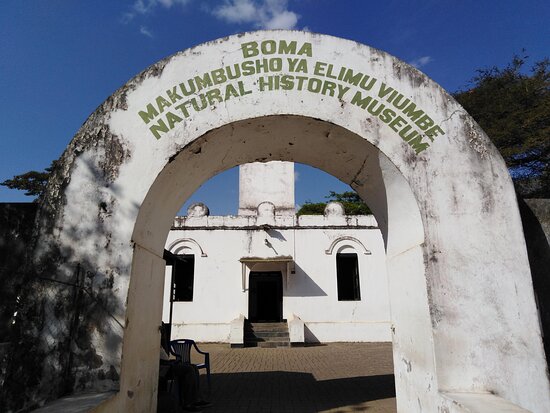
There was a road that led to the compound from the south and had trees on either side of it for the duration of this time. With some of the original trees still present, this road still exists today and bears the name of the compound—Boma Road.
THE BOMA NATURAL MUSEUM: WHAT TO DO THERE?
Discover the history of the Arusha area from the late 19th century to the middle of the 20th century (the Declaration Museum has more information on 20th-century history). Additionally, you can discover a great deal more about the creatures and insects that inhabit nearby national parks as well as typical residences.
Numerous artifacts from nearby excavations are also available for viewing, including lifelike sculptures of early humans and the famous Zinjanthropus skull from Olduvai Gorge (a replica). A gallery where some local artists exhibit their work is located at the back of the museum.
If you’re lucky, you might catch one of them at work or, in exchange for a small fee, learn how to make some art of your own. Along with drum-making instruction, the art section also sells art. Don’t forget to look at the actual fish, turtles, and eagles.
LOCATION OF THE BOMA NATURAL HISTORY MUSEUM
The Boma Natural History Museum of Arusha is situated in a peaceful, tree-lined neighborhood of the city of Arusha, Tanzania, at the uphill end of Boma Road. Additionally, it is located deep inside the CBD and just a short distance from shops, offices, hotels, and restaurants. It is also located in the Themi River’s riparian zone, which runs through the city and out of its southern suburbs from the mountain’s slopes. The museum is a great place for a short break after your Mount Kilimanjaro climbing adventure or after a visit to the Northern Safari circuit.
THE BOMA NATURAL MUSEUM: HOW DO I GET THERE?
The clock tower, a well-known city landmark, would need to be reached first with private transportation before continuing uphill (north). The Boma Museum can be found at the end of the road that bears its name and runs north. If you’re taking the bus, look for one that is going to the clock tower or the Arusha hotel district, and get off at the clock tower stop. You can reach the museum by taking a short, uphill stroll for ten minutes from there.