
How to Get to Shimba Hills National Reserve? Shimba Hills National Reserve is a small national reserve in the former coast province of Kenya, in Kwale County, Kenya. 33km from Mombasa and 15 km from the coast. The reserve is an area of coastal rainforest, woodland, and grassland, it is an important area for plant biodiversity over 50% of the 159 rare plants in Kenya are found in the Simba Hills, including some endangered species of cycad and orchids. It is also a nationally important site for birds and butterflies.
Shimba National Reserve has a variety of wildlife that is animal species and bird species in the reserve is the endangered Sable Antelope, over 700 elephants, giraffes, leopards, genet, civet cats, hyenas, waterbuck, bush pig, buffalo, African bush baby, Bushbuck, Coastal Black and white colobus, Blue Duiker, Bush Duiker, Red duiker, Greater Galago, Black-faced Vervet, Monkey, Sykes Monkey, Serval cat, Black and Red Shrew, Knob. Bird species include the African fish eagle, Black-collared barbet, Brown-hooded kingfisher, crested guineafowl, Golden palm weaver, and many others.
If you’re planning to visit Shimba Hills National Reserve, there are several convenient ways to get there.
By Road
If you’re driving from Nairobi, you’ll need to cover about 522 kilometers, which usually takes around 7 hours. To start your journey, you’ll first head toward the ferry at Likoni, which will take you across to the southern coastline. As you make your way, you’ll pass through popular spots like Tiwi and Diani beaches. Once you’re on the A14 coast road, head south for about 10 kilometers until you reach a main crossroad. From there, take the road that leads up towards Kwale Town on the C106. The entrance to the reserve is just 1 kilometer from that road and about 3 kilometers from Kwale itself. If you’re coming from Mombasa or Diani Beach, getting to the reserve is pretty straightforward and usually takes only about an hour.
By Air Means
To reach the Shimba Hills National Reserve by air, travelers often use charter flights arranged by knowledgeable tour operators. For those flying from Nairobi, most domestic flights depart from Wilson Airport, which is only 6 kilometers south of the city center.
There are daily flights available to popular destinations like Mombasa and Diani Beach. Carriers such as Kenya Airways and Fly 540 frequently operate flights to Mombasa, while other airlines like Air Kenya, Mombasa Air Safari, Safari Link, and East Africa fly to Diani Beach. Once you land in Diani, it’s about an hour’s drive to the reserve, and this transport can typically be arranged by your tour operator, making your journey smooth and simple.
Top things to do at Shimba Hills National Reserve
Game drives
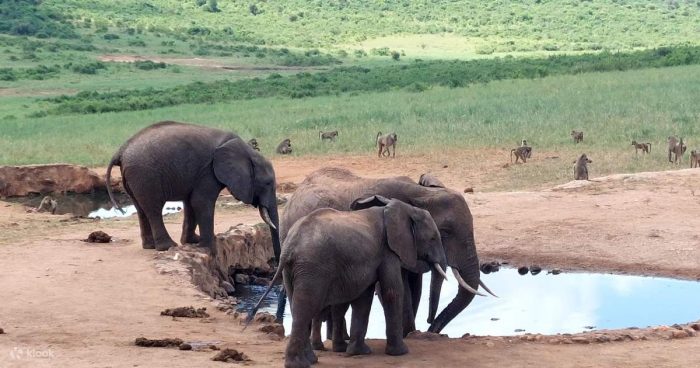
Shimba Hills National Reserve is a fantastic place to observe wildlife, especially for those interested in seeing elephants and the unique sable antelope. In addition to these majestic creatures, the reserve is home to a variety of other animals, such as giraffes, leopards, genets, civet cats, hyenas, waterbuck, bush pig, buffalo, African bush baby, Bush bucks, Coastal Black and white colobus, Blue Duiker, Bush Duiker, Red duiker, Greater Galago, Black-faced Vervet. However, because of the dense forest cover, spotting animals can be quite challenging compared to open savannah landscapes. During your game drive safari, you’ll have the chance to spot these fascinating creatures roaming in their natural habitat
Bird watching
Shimba Hills National Reserve is a fantastic place for bird-watching in Kenya. the reserve is home to unique and rare bird species such as Croaking Cisticola and the Zanzibar Red Bishop, two special birds that can only be found here. During your birding safaris, you have the chance to spot different colorful bird species beyond such as the green barbet, Fischer’s turaco, Golden palm weaver, mottled swift, Narina trogon, and Red-necked spurfowl, and among others. The reserve offers a great chance to connect with nature and spot these unique species in their natural habitat.
Explore Mwaluganje Elephant Sanctuary
In response to the challenges posed by the growing elephant population in Shimba Hills National Reserve, Mwaluganje Elephant Sanctuary stepped in to help. This sanctuary serves as a safe passage for the elephants, allowing them to move out of the reserve and helping to lessen the clashes between humans and wildlife. During your visit here, you will have the chance to learn about the history of the Elephant Sanctuary, its challenges, and the benefits to conservation.
Take a Refreshing Dip at Sheldrick Falls
Sheldrick Falls is a must-visit at the park. It is 2 kilometers walk along a marked footpath that is best done in the company of a Kenya Wildlife Service ranger because elephants and a few buffalo occasionally show up. Between 10:00 AM and 3:00 PM. You can even swim safely in the refreshing water pool or have a picnic by the cascades on the sand.
The water level in the pool changes throughout the year. When the rainy season comes, there’s a single waterfall, and the pool fills up, making it perfect for a swim. However, during the dry season, two waterfalls appear but the pool shrinks, leaving little room for swimming. Late afternoon is the ideal time to visit to enjoy the scenery. The falls are named after the well-known game warden, David Sheldrick, and they drop 25 meters in height. David was known for his remarkable work in taming the harsh Taru desert, now recognized as Tsavo National Park, which has become one of Kenya’s most renowned wildlife destinations. It’s said that he was the first person to discover these falls, which were unknown even to the local villagers.