
Frequently asked questions (FAQs) about Ebola disease in Uganda : Due to its many attractions, including mountain gorilla trekking in Bwindi Impenetrable National Park, game drives in Queen Elizabeth and Murchison Falls National Parks, hiking safaris in the Rwenzori Mountains, and cultural tours in Kampala City, Uganda is the most popular and most visited safari destination in Africa. However, at the moment, many travelers are hesitant to go and visit because of the current Ebola disease outbreak. The Uganda Ministry of Health announced the presence of Ebola in Uganda on September 20, 2022, and since then, many questions have been asked about the virus’s origins, effects on expectant and nursing mothers, signs and symptoms, and if it is still safe to travel to the country. Focus East Africa Tours is here to answer any of your questions concerning the Ebola outbreak in Uganda and to reassure all of its visitors that traveling to Uganda and the rest of Africa is completely safe.
What is Ebola Virus Disease (EVD)?
The Ebola Virus Disease (EVD), formerly known as Ebola hemorrhagic fever, is a rare but deadly condition that can quickly lead to death if not treated, according to the World Health Organization (WHO). The virus has a wild animal origin but spreads among people via transfer from person to person. Cueva virus, Marburg virus, and Ebola virus are the three genera that make up the virus family Filoviridae. Six distinct species of the Ebola virus have been found: in Zaire, Bundibugyo, Sudan, Ta Forest, Reston, and Bombali.
Up to 90% of the mortality associated with Ebola virus disease (EVD) epidemics in the past has been documented. This illustrates how deadly the disease can be in the moment when it is not treated.
History and origin of Ebola Virus Disease (EVD)
The World Health Organization (WHO) claims that the first two epidemics of the Ebola virus disease (EVD) occurred simultaneously in 1976 in what is now Nzara, South Sudan, and Yambuku, the Democratic Republic of the Congo, respectively. The latter took place in a community close to the Ebola River, which gives the disease its name. The largest Ebola outbreak since the disease first appeared in 1976 happened in West Africa from 2013 to 2016. After beginning in Guinea, the pandemic spread to Sierra Leone and a few locations in Liberia.
The 2000 outbreak, which resulted in 425 infections and 224 fatalities, was by far the greatest of Uganda’s five Ebola virus disease outbreaks. Of the five outbreaks, the Sudan Virus species was responsible for four of them. This demonstrates how dangerous the disease was at the time and how the response was not as effective as it is now.
How is Ebola virus disease (EVD) transmitted? – How is Ebola transmitted?
Experts and specialists concur that Pteropodidae fruit bats naturally carry the Ebola virus. Thus, the virus can be passed directly from infected animals, such as fruit bats, chimpanzees, gorillas, monkeys, forest antelope, or porcupines discovered sick, dead, or in the rainforest, to people by contact with their blood, secretions, organs, or other bodily fluids. In addition, the Ebola virus disease can be transmitted directly from person to person by coming into contact with:
- Blood or bodily fluids from an Ebola patient who is ill or has passed away
- Items that have been contaminated with bodily fluids (such as blood, feces, or vomit) from an Ebola patient or the body of an Ebola victim
- Additionally, it’s feasible for women who contract the Ebola virus during pregnancy and recover to pass the illness on to their unborn children. This means that before starting to breastfeed their newborns, moms should have their milk checked.
What are the symptoms of Ebola Virus Disease (EVD)?
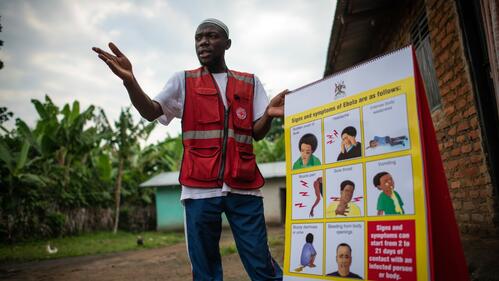
The human body can incubate the Ebola virus for 2 to 21 days. Before any of these symptoms occur, the sick person cannot transmit the illness to another.
- Fever
- Fatigue
- Muscle pain
- Headache
- Sore throat
Frequently asked questions (FAQs) about Ebola disease in Uganda
The aforementioned symptoms first arise; however, as the virus progresses, the infected person will also experience the following symptoms:
- Vomiting
- Diarrhea
- Rash
- signs of poor liver and renal function
- Both internal and exterior bleeding can occur occasionally (for example, oozing from the gums or blood in the stools).
How can you diagnose Ebola virus disease?
Particularly in its early stages, Ebola exhibits symptoms that are closely akin to those of other common diseases like malaria. It is advisable to consult a doctor as soon as any symptoms start to occur in order to receive a professional diagnosis because this makes it harder to diagnose.
Where is the Ebola outbreak in Uganda? Is Ebola in Uganda?
Despite the fact that it has taken a while, Ebola has not recently spread to larger part of Uganda. The districts of Mubende, Kagadi, Kyegegwa, Kassanda, and Bunyangabo in Uganda is where the disease have lately been confirmed. A 24-year-old male Ugandan who had the symptoms and tested positive for the Ebola virus was the first case of the disease to be recorded in the Mubende district of central Uganda. The case wasn’t imported from elsewhere; it was created locally.
How many Ebola cases are there in Uganda so far?
Ten fatalities, 44 confirmed cases, and 20 suspected cases have been reported in Uganda as of October 9th, 2022; however, the Ministry of Health consistently reassures the public that the issue is under control. Doctors and nurses who got the illness while working in hospitals and Ebola treatment facilities are among the cases. The bulk of these doctors, along with other Ebola patients, have totally recovered and have been sent home, which is the good news. It should be emphasized that as the days pass, the number of Ebola cases changes as new patients are discovered and others are released after making a full recovery.
Can you survive from Ebola disease?
As long as the patient seeks medical attention promptly and reports to the doctors in a timely manner, they can survive the Ebola virus disease. There are several accounts of Ebola patients who have recovered, not just from the most recent outbreak but also from those in the preceding years. Like any other sickness, all you need is the appropriate medicine at the appropriate time, Frequently asked questions (FAQs) about Ebola disease in Uganda.
Who is immune to Ebola?
Good supportive treatment and the patient’s immunological response are essential for Ebola Virus Disease recovery. The overall survival rate is also rising because of experimental therapies. Those who do recover produce antibodies that may persist for up to 10 years. It is believed that survivors have some protection from the strain of Ebola that initially afflicted them. It is unknown if those who recover have a lifelong immunity to the disease or if they can subsequently contract another type of the Ebola virus. Long-term consequences like joint and eye issues could affect some survivors.
How long does Ebola last in a person?
The virus may persist after an acute infection in parts of the body that are immunologically privileged locations, according to the Centers for Disease Control and Prevention. Even after being eliminated elsewhere in the body, viruses and other pathogens, such as the Ebola virus, can hide in these locations from the immune system of the survivor. The cerebrospinal fluid, the testes, the inside of the eyes, the placenta, and the central nervous system are among these regions. It depends on the survivor whether the virus is present in various body parts and for how long.
In order to better understand how to treat and care for EVD survivors, researchers are still looking into the long-term repercussions of Ebola virus infection, including viral persistence.
Key facts about the Ebola virus disease
- Humans occasionally contract the severe, frequently fatal disease known as Ebola virus disease (EVD), formerly known as Ebola hemorrhagic fever.
- The virus spreads among humans through human-to-human contact and is spread to people by wild animals.
- Around 50% of Ebola Virus Disease cases end in death on average. In previous epidemics, case mortality rates ranged from 25% to 90%.
- For outbreaks to be successfully controlled, community involvement is essential.
- A variety of interventions, including case care, infection prevention and control procedures, surveillance and contact tracing, a top-notch laboratory service, safe and respectable burials, and societal mobilization, are necessary for effective outbreak control.
- Ebola vaccines have been created and deployed to help contain the spread of epidemics of the disease in Guinea and the Democratic Republic of the Congo (DRC).
- Women with Ebola who are pregnant or nursing should receive early supportive treatment. The same goes to those who are not pregnant.
How to prevent and control Ebola Virus Disease (EVD)
All parties involved and everyone on the ground must work together for viruses like the Ebola virus to be successfully contained. Here are a few of the World Health Organization’s (WHO) suggested preventive practices.
Lowering the risk of human infection from contact with diseased fruit bats, monkeys, apes, forest antelope, or porcupines, as well as from eating their raw meat. When handling animals, gloves and other suitable protective clothing should be worn. Before eating, animal items like meat and blood should be fully checked and prepared.
Minimizing the possibility of human-to-human transmission through direct or close contact with those who are experiencing the symptoms of Ebola, especially through their bodily fluids. When caring for sick patients, gloves and the proper personal protective equipment should be worn. Both after visiting patients in the hospital and after providing care for patients at home, regular hand washing is essential.
Measures to stop the spread of the outbreak include burying the dead safely and respectably, tracking anybody who may have been in contact with an Ebola patient for 21 days, separating the healthy from the ill to stop further transmission, practicing excellent hygiene, and keeping the environment clean.
The WHO advises male Ebola Virus Disease survivors to practice safer sex and hygiene for 12 months following the onset of symptoms or until their semen tests negative for the Ebola virus twice in order to reduce the risk of potential sexual transmission. This recommendation is based on additional analysis of ongoing research and consideration by the WHO Advisory Group on the Ebola Virus Disease Response.
Pregnant women who have survived the Ebola disease need community support to enable them to attend frequent antenatal care (ANC) visits, handle any pregnancy complications, meet their need for sexual and reproductive care, as well as deliver their babies safely. This reduces the risk of transmission from pregnancy-related fluids and tissues. Planning for this needs to take into account obstetric and Ebola healthcare skills.
How to Protect Ebola Survivors from Spreading the Virus
Until their semen has been twice tested negative, all Ebola survivors and their sexual partners should get counseling to guarantee safer sexual practices. Condoms ought to be made available to survivors, Frequently asked questions (FAQs) about Ebola disease in Uganda.
Semen testing for male Ebola survivors should begin three months from the disease’s commencement and continue every month after that, if they test positive, until their semen test negative for the virus twice by RT-PCR, with a one-week gap between tests. The sexual partners of Ebola survivors should:
Avoid having any intercourse at all, or observe safer sex by using condoms correctly and consistently up until their semen has tested negative twice.
Having tested negative, survivors can resume regular sexual behavior without worrying about the Ebola virus spreading.
In order to maintain good hand and personal hygiene, survivors should wash their hands right away with soap and water after any physical contact with semen, especially after masturbating, until their semen has been tested twice and has come back negative for Ebola. Used condoms should be handled carefully during this time and disposed of safely to avoid coming into contact with seminal fluids, Frequently asked questions (FAQs) about Ebola disease in Uganda
All survivors, their lovers, and their families deserve to be treated with honor, respect, and compassion.
Is it safe to travel to and visit Uganda these days?
In a recent letter to the public, the Ugandan Ministry of Health (MOH), under the direction of Dr. Jane Ruth Aceng, emphasized how safe it is to enter and exit Uganda. She claimed that the situation was under control and that everyone could travel freely within the nation. During his national address on the Ebola outbreak, the President of the Republic of Uganda highlighted this, saying, “We [Uganda] shall not have lockdowns like those that happened during COVID-19, since the Ebola virus is under control.”