
Exploring the beauty of Lake Turkana: Lake Turkana, formerly Lake Rudolf, lies in the Rift Valley of East Africa. It is about 250 kilometers long and 15–30 kilometers wide, with an average depth of about 30 m. Lake Turkana is one of the largest desert lakes in the world, and it lies in a closed basin in northwestern Kenya and southwestern Ethiopia. These images show the delta of the Omo River, which provides more than 80% of the water to the lake. The lake has no outlet and lies in an arid area.
The area is inhospitable but eerily beautiful, and the lake’s three islands are a stopover for migrant birds and a breeding site for crocodiles and hippos. The lake features a variety of exciting attractions such as Scenery, cultural visits, and bird watching. There are big mammals in Sibiloi National Park on the shore of the lake, but this is not primarily a safari destination
Wildlife
Exploring the beauty of Lake Turkana might not be your typical wildlife hotspot, but it has gained a reputation for its impressive crocodiles and lively bird colonies. Central Island, accessible by boat, is home to around 120,000 Nile crocodiles that breed in its waters. The surrounding Sibiloi National Park is a refuge for unique animals native to northern Kenya, like the reticulated giraffe, Beisa oryx, lesser kudu, gerenuk, and Grevy’s zebra. While lions, leopards, and cheetahs do roam the area, they are quite elusive.
Scenery
The area around Lake Turkana is marked by rugged volcanic rock and is often buffeted by a strong, dry wind. The sparse vegetation is tough and spiky, thriving in these harsh conditions. The lake’s shimmering turquoise waters have earned it the nickname ‘Jade Sea’ due to its vast size. Over the years, the lake’s water level has changed dramatically; it was once about 100 meters higher thousands of years ago.
Birdlife
Exploring the beauty of Lake Turkana: Lake Turkana is one of the best birding destinations in Kenya, the lake is surrounded by vibrant landscapes, rolling hills, forests, and swamps which act as a habitat for a variety of these birds. Some of the bird species found here include Common Ostrich, Somali Ostrich, Shoebill, Hamerkop, Black-crowned Night Heron, Secretary bird, Osprey White-faced Whistling-Duck, African Black Duck, Vulturine Guineafowl, Helmeted Guineafowl, Stone Partridge, Orange River Francolin, Yellow-necked Spurfowl, Speckled Pigeon, Mourning Collared-Dove, Black-faced Sandgrouse, White-bellied Bustard, Kori Bustard, White-bellied Go-away-bird, White-crested Turaco, Senegal Coucal, African Emerald Cuckoo, Eurasian Nightjar, White-rumped Swift, Streaky-breasted Flufftail, Gray Crowned-Crane, Greater Flamingo, African Openbill, African Woolly-necked Stork, Great Cormorant, Great Cormorant, Eurasian Spoonbill and Great White Pelican among others
Weather and Climate of Lake Turkana
Situated in Kenya’s dry northern region, Lake Turkana is known as the hottest part of the country, with daytime temperatures averaging around 34 degrees Celsius (93 degrees Fahrenheit). It receives very little rainfall less than 300mm (12in) a year with the main rainy season peaking in April and a shorter one in November.
Best Time to Visit
Lake Turkana has a desert climate and rainfall is very low. The area can be visited at any time, but the scenery is most stunning after the rains, which peak in April and November. The wetter months should be avoided if you are driving up from Nairobi, as some tracks might become difficult to navigate.
LAKE TURKANA NATIONAL PARKS
Central Island National Park
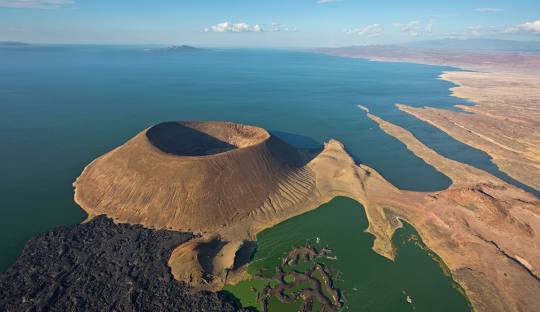
Central Island National Park, often called Crocodile Island, is a stunning volcanic island situated in the middle of Lake Turkana in Kenya. This lake is one of the most saline great lakes in Africa and is made up of three main lakes which are the Tilapia Lake, Crocodile Lake, and the Flamingo Lake. Covering an area of bout 5 square kilometers, making it one of the smallest national parks in Kenya, it offers visitors unforgettable experiences immersed in nature. The active volcanoes pass out Sulphur smell often times and the lakes there are endowed with Nile crocodiles. The island has the largest place for concertation of crocodiles and the island is one of the world’s pristine nature places not tempered with its nature. The park has archaeological and paleontological sites together with very beautiful sceneries of the magnificent lake and scant island vegetation.
The highest point of this basaltic island measures 355 meters above the lake’s surface and sits in the middle of Lake Turkana which is the largest permanent desert lake in the world that forms blue and green waters. The park, which is managed by the Kenya Wildlife Service and recognized as a UNESCO World Heritage site, is rich in archaeological and paleontological treasures and boasts stunning scenery that captures the beauty of the lake and the sparse island vegetation.
South Island National Park
South Island National Park also known as the Isle of Misery,” is covered end to end in volcanic ash. The nightly glow of this South Island’s luminous vents has inspired numerous tales of ghosts and evil spirits. It is an island located in the southern part of Lake Turkana. It has a surface area of 39 km2 and is protected as a national park under the Kenya Wildlife Service. It was gazetted as a national park in 1983 and a UNESCO World Heritage site in 1997 for its remarkable iridescent vents that glow at night.
South Island National Park is located about 716 kilometers from Nairobi and is a vital stop for many migratory birds, making it an Important Bird Area (IBA). Each year, between March and May, you can witness an impressive array of 34 European bird species as they stop here on their journey home. The park is also home to at least 23 breeding bird species, including the majestic Goliath herons and the unique African skimmers. Along the shores, you’ll find African open-billed storks, ducks, and gulls looking for food, while the park’s volcanic island lakes draw in flocks of lesser flamingos. Bird watchers will especially enjoy spotting the various birds of prey, with the swallow-tailed kites being particularly prominent. Additionally, this beautiful park is recognized as a remarkable place for wildlife viewing and boasts the largest crocodile population in the world, making it a must-visit spot in Kenya.
Sibiloi National Park
Sibiloi National Park covers an area of about 1,570 square kilometers and is situated on the east shore of Lake Turkana in northern Kenya near the border with Ethiopia. The region is at the western edge of the Somali arid climatic zone. It receives unreliable seasonal rainfall of 25cm per year mostly during March and April. Temperatures range from 26” – 37” with strongly south-easterly winds a persistent feature. The region is part of the East African Rift System with gently sloping hills and volcanic cones. The park encompasses one of the largest petrified forests. Lake Turkana formerly Lake Rudolph is the main source of water to the park’s ecosystem.
More so, the park was named after Mount Sibiloi in view of Alia Bay on the south perimeter. National Park serves as a stopover for migrant birds and waterfowl and is also a major breeding ground for the Nile crocodile. The park is home to over 350 species that have been recorded. Desert wildlife includes Oryx, Grant’s gazelle, and Grevy zebra. Elephants, rhinos and buffalo all disappeared from the region in the early part of this century and is also a major breeding ground for the Nile crocodile. The park is famously known for its fossil deposits found in a part of the park known as Koobi Fora. Remains of early man have been found here along with many thousands of specimens of fossil vertebrates, mainly mammals.
Getting There
Lake Turkana is about 665 kilometers (414 miles) north of Nairobi. The town of Loiyangalani on the southeastern shore can be reached via charter flight or organized truck trips. Flights are also available to Sibiloi. You can catch scheduled flights to Lodwar on the western side of the lake from Nairobi’s Jomo Kenyatta International Airport and Eldoret.
Multiple routes lead to the eastern and western shores of the lake, although there is no road connecting the two sides. Boat crossings can be arranged, but they might be costly. Some paths have been partially paved, improving accessibility. For those keen on a self-drive adventure, experienced 4×4 enthusiasts can make the journey, ideally traveling in a convoy for safety. The trek from Nairobi requires crossing either the Chalbi or Karoli Desert.