
Explore Karamoja’s Wildlife And Cultural Tours : Travelers who want to see both wildlife and rural African villages should take the Karamoja Plains Tour. Northeastern Uganda’s Karamoja is a semi-arid region bordered to the north by South Sudan and to the east by Turkan County in northern Kenya. Numerous Nilotic-speaking tribes, including nomadic cattle warriors and Bushmen, live in the region.
They are referred to collectively as the Karamojong, and they are made up of three main ethnic groups: the Dodoso, Jie, and Karamojong, the latter of which is further divided into the Bokora, Matheniko, and Pian. The Karamoja Plains Tour provides chances for adventure and cultural travel. Along with hiking dry volcanic mountains like Mt. Moroto and Mt. Morungole, visitors can go motorcycling or mountain biking along historic cattle routes. They can also visit hot springs, artisanal gold mines, and markets for arts and crafts in Karamoja. You can also go on a wildlife safari In Kidepo Valley National Park or Pian Upe Wildlife Reserve. They are the only place in Uganda where you can find endangered species like cheetahs, striped hyenas, black-backed jackals, and ostriches.
TOURISM VILLAGES
The Karamojongs have continued to live in their traditional semi-nomadic ways, in contrast to the rest of Uganda. The best rural tourism destination in Uganda is the Karamoja region. The majority of the inhabitants of Karamoja are Nilotic speakers, and for centuries, the Karamojong nomads have roamed the semiarid savanna grasslands with their herds of cattle, goats, and sheep. The splendor of the earliest rural African settlements is visible. The Kotido district is home to Nakapelimori, the largest Karamojong village. On your way to Kidepo Valley National Park, you can stop by. The Jie people, who are also found in South Sudan, reside in the village.
HIKING MOUNT MOROTO
The semi-arid plains beneath the tallest mountain in Karamoja, Mount Moroto, 3,083m (10,007 feet), offer the best camping and hiking for novices. The Moroto district at the foot of the volcano is the biggest town in the area. The town is situated 460 kilometers (8 hours) to the northeast of Kampala, the country’s capital; 175 kilometers (3 hours) to Kapchorwa and Sipi Falls on Mount Elgon’s northern slopes; and 240 kilometers (5 hours) to Kidepo Valley National Park. Moroto town acts as a hub from which to explore the Karamoja plains as a result. Depending on the destinations chosen, you can take roundtrips from there that last anywhere between 1 and 5 days.
The Mount Moroto hike, which starts in the town, offers breathtaking views of the Karamoja plateau. For those wishing to ascend Sokodek and Imagit, there are either one- or multi-day hikes available.
HISTORIC NOMAD CATTLE TRAILS
Over time, the Karamojong nomads established storied cattle routes. Including Kenya, South Sudan, and Ethiopia, as well as the entire Horn of Africa, excluding just Uganda. Their main problems are food insecurity and a lack of pastures and green water because of the severe drought and climate change. Additionally, because some of their historical routes have been blocked by protected areas and development, they are unable to move their livestock as they once could. The Ugandan government has constructed valley dams and is helping farmers adapt to climate-smart agriculture in order to ensure water availability. The Karamojong, however, are committed to upholding their traditions. The development of nomad warrior trails that allow for biking through the Karamoja plains was aided by tourism. In order to prevent armed cattle rustlers, security has also been boosted. As a result, tourists can now drive, ride motorcycles, and travel by bicycle from Uganda to Turkana County in Kenya.
THE ATEKER PEACE CARAVAN
Among the Ateker peoples, who can be found in Uganda, South Sudan, Kenya, and Ethiopia, the Ateker caravan is one of the last remaining traditional pilgrimages. A few of these are the Nyagatoma, Jie, Karamojong, Teso, Lango, and Taposa tribes. Through rural tourism, their semi-nomadic culture and way of life are being preserved. To promote peace and foster unity, the Ateker Trail was established and is held annually. Visitors are welcome to join the excursion.
TRADITIONAL HOMESTEADS
The term “Karimojong” is used to describe a number of semi-nomadic tribes, such as the Jie, Tepeth (Soo), IK, Taposa, Dodoso, Karimojong, Pian, Matheniko, and Bokora. Some of them, such as the Soo and Ik (who live on the slopes of the Moroto and Murongule mountain ranges, respectively), were formerly hunters and gatherers but are now embracing agro-pastoralism, which necessitates a switch from raising livestock to cultivating crops, particularly in light of the severe drought conditions that have been present.
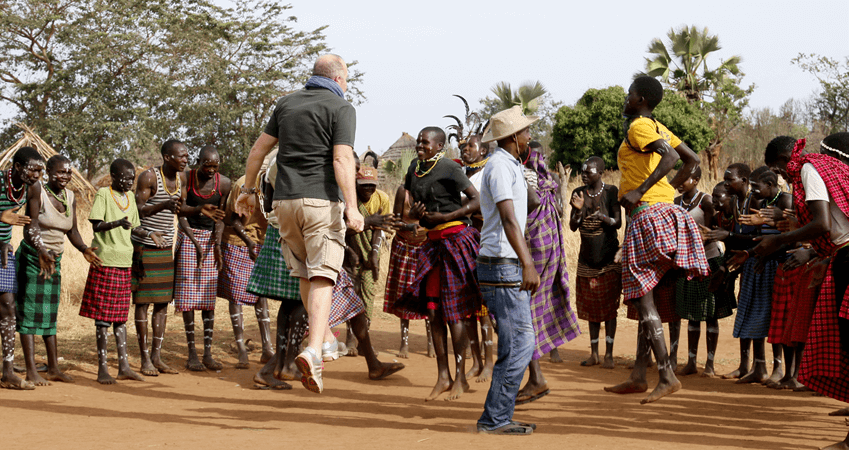
Their way of life hasn’t changed much over the years, but their occupations are slowly changing. They continue to reside in fortified settlements known locally as Manyattas, which is Kenyan for “kraal.” One of the few places to see authentic African village life is Karamoja. The Karamojong Manyattas are some of Sub-Saharan Africa’s most beautiful rural tourism villages because they are surrounded by rock formations. There are accommodations available for guests who want to spend the night with the warriors. These include the Karamoja safari camp in Moroto town, Timu forest, and eco camps on Mount Morungole .
You can discover more about their way of life, including their approach to music, drama, and food preparation. You can also go see their cattle kraals to see how they still practice customs like drinking raw cow’s blood.
It is possible to visit the regional markets in Moroto town during the day, where you can talk to the energetic locals. When people from various ethnic groups congregate in one place, you can expect to learn more about their cultures. You can simply purchase trinkets or go see black and gold smiths and herbalists for their breathtaking metaphysics. Others bring food and jewelry, while others bring their cattle and camels for sale. Additionally, you can observe how they make crafts like pottery, furniture, and clothing.
SPOTTING WILDLIFE IN KIDEPO VALLEY NATIONAL PARK
Kidepo Valley National Park, the true wilderness of Africa, is another place you should go while taking a tour of the Karamoja plains. Over 77 different mammal species and over 450 different bird species can be found in the protected area. Cheetahs, Aardwolves, and striped hyenas can only be seen in Kidepo, Uganda. Large mammals such as lions, leopards, buffaloes, elephants, Uganda kobs, Jackson’s hartebeests, and plains zebras are also found in the park.
PIAN UPE WILDLIFE RESERVE
Pian Upe Wildlife Reserve should also be a part of your tour of the Karamoja Plains. The protected area is 878 square miles (2,275 square kilometers) in size and contains Mount Kadam, Karamoja’s second-tallest volcano at 10,049 feet (3,063 meters). Hiking and wildlife viewing are both possible when visiting Pian Upe Wildlife. Grant’s gazelles, roan antelopes, common eland, waterbucks, Bohor and mountain reedbucks, Gunther’s dik-dik, klipspringer, impala, Uganda kobs, and oribi are just a few of the rare antelope species that can be found in the reserve. An intermediate 25-kilometer roundtrip hike is Mount Kadam. The trails are kept up better than the campgrounds are. It is recommended that hikers either bring their own equipment or rent it and stay at Terrace Eco Gardens in the Nakapiripirit district.
The length of a tour of the Karamoja plains can range from three to fourteen days, depending on the locations you’d like to see. Rely on the tours that can be reserved through a tour operator.