
The Kasubi tombs are found in Uganda capital city, Kampala, positioned on a hill it’s a burial place for the four Kabakas (kings) of the Buganda kingdom, this traditional burying place was formerly known as Nalubagala, residing on 30 hectares of land.
The Kasubi traditional tombs serve as an active religious site primarily for the Baganda people, especially the royal family, since four of the previous Kabakas were buried there. the baganda people have a very rich culture you can explore and learn from the people even through visiting the Kasubi tombs.
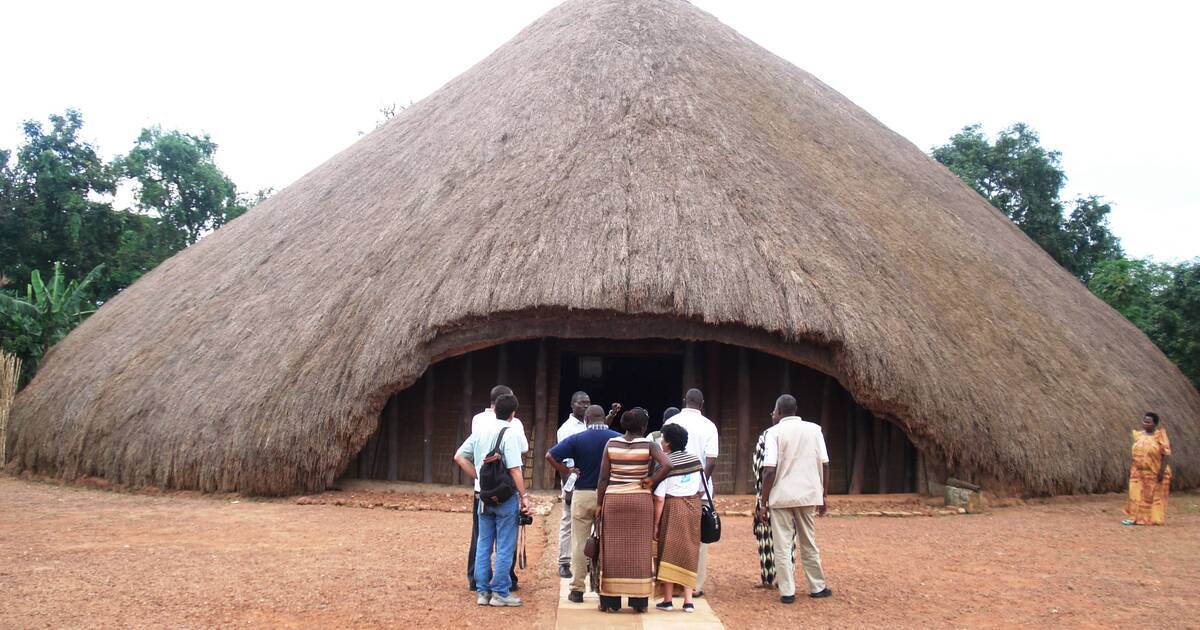
The main building where the tombs lie is Muzibu Azzala Mpanga, built in an African traditional architecture tapestried with thatch, Reed, daub, wattle and wood; the rest of the site is covered in plantations of traditional methods. The first Kabaka to be buried at the Kasubi tombs is said to have been Kabaka Muteesa I, who was the 35th Kabaka of the Buganda kingdom.
At the Kasubi tombs, the real tombs are hidden behind a bark cloth, and the place behind is known as Kibira or forest. In front of the curtain are raised platforms showing the position of each of the Kabakas and their names.
The first Kabaka of the baganda is said to have been Kintu, who won his wife’s hand in marriage, Nambi, by performing heroic deeds for the father of Nambi, who was known as Gulu. Gulu was the god of the sky. Kintu is said to have disappeared into Mangonga forest and died there.
The Kasubi tombs were listed as a world heritage site by UNESCO in December 2001; they were built in 1882 and converted into a burial ground in 1884. The Kasubi tombs were recognized as one of the most typical buildings built with vegetal materials in the whole sub-Saharan region.
The baganda people take the Kabaka as a symbol of the spiritual, social and political state of the kingdom, the Kabaka is always highly respected within all the baganda clans. the Mazibu Azzala Mpanga has existed since the 13thcentury.
In the month of March 2010, the Kasubi tombs were endangered when the fire broke out and the cause of the fire is yet to be known and is under investigation, after the fire, the reconstruction of the tombs started to take place with the help of the Ugandan government and funding from Japan. The recent Kabaka Ronald Mutebi II announced a week of mourning after this fateful event occurred in 2010. Some great documents about the site were also burnt in the fire.
Kasubi tombs contribute to Uganda foreign earnings, as they are visited by large numbers of international tourists annually while on Uganda Cultural Tours, rituals of the baganda are being performed here regularly, as it’s believed by the baganda people that traditional, historical and cultural values are attached to the site.
The Kasubi tombs have greatly contributed to the preservation and maintenance of the baganda culture, norms and values. The dead baganda Kabakas are believed to communicate with their successors.
Brief history about the four Kabakas
Kabaka Muteesa 1 succeeded his father Kabaka Suuna and built his palace in Kasubi. Muteesa 1 broke two traditional baganda rules first he commanded that his jawbone should not be removed and that he should be buried whole, which was not so with the baganda culture; secondly, he got buried in his former palace. Kabaka Muteesa 1 also had many women unlike other earlier Kabakas, he also involved himself in the ivory trade and welcomed Europeans to the baganda kingdom; the first to visit was John Speke in 1862. He sadly imprisoned his brothers and dumped them in a trench, where most died due to fear of rebellion.
Kabaka Mwanga 1 succeeded his father, Kabaka Mwanga. Kabaka Mwanga was very brutal and commanded the killing and burning of all Muslims and Christian converts in 1886. The Kabaka’s commanding chiefs were not happy so they joined powers to overthrow him.
Kabaka Mwanga II contributed together with the Bunyoro Kitara king Kabalega against the colonial British rule; however, they were not successful they got defeated and exiled to Seychelles island where he died in 1903 and his remains were brought home in 1910 and buried in the Kasubi tombs.
After the death of Kabaka Mwanga II, his son Daudi Chwa succeeded him. At the age of one year, this king ruled with the help of two chiefs until he was the age of 18 years; he died in 1939 and was also buried in the Kasubi tombs, hence making the site an important place for the baganda kingdom.
Kabaka Edward Muteesa II succeeded his father king Daudi Chwa, during the changing of the Buganda 1900 agreement, Muteesa II got into a dispute with the then rulinggovernor of Uganda, the Kabaka was exiled in England and later returned in 1955 and when Uganda gained her independence in 1962, the Kabaka became the constitutional president of Uganda. Sadly, the Kabaka’s palace was seized in 1966 with an order from Prime Minister Obote, he died in 1969 in London; his remains were brought in 1971 and buried at the Kasubi tombs.
The baganda kingdoms are always built on top of hills to control roads leading to the palace, there is a lot to learn about Kasubi tombs and the baganda culture it would be a very good idea to visit this place while in Uganda.
The Kasubi royal tombs can be accessed from the city center in about fifteen minutes; it’s just a five-kilometer drive located along Kampala-Hoima road.