
What are the wildlife species found in Lake Nakuru National Park? Lake Nakuru National Park is one of the rift valley lakes situated at an elevation of about 1,755 meters above sea level. Lake Nakuru national park is located in the south of Nakuru County with Nakuru Town as the nearest developed town, about 164 kilometers about 2 hours drive from Nairobi City the capital of Kenya. Lake Nakuru National Park is a UNESCO World Heritage Site recognized in 2011, an Important Birding Area recognized in 2009 and a Ramsar site recognized in 1990. Lake Nakuru National Park is a wildlife kingdom and a birders paradise in Kenya with scenic views created by Lake Nakuru, millions of pink flamingos, and other picturesque sites dotted around the park, the park covers an area of 45 square kilometers.
Lake Nakuru National Park is one of the great wildlife habitats in Kenya hosting about 56 different species of mammals including 4 of the big 5 exclusive of African elephants. The park is also home to over 450 different colorful bird species. The best time to view wildlife in the park is during the dry season, from June to February. However, the wettest months are April and May, when roads can become impassable and the grass can grow too high to see the animals
Here are some of the commonly spotted wildlife species in Lake Nakuru National Park, they include;
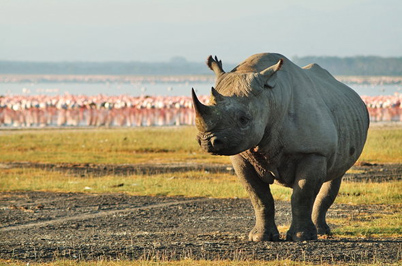
Black and white rhinos
Rhinos are some of the most recognizable animals in Africa, and they’re part of the famous “Big Five.” At Lake Nakuru National Park, you can find both black and white rhinos living together. Despite their names, neither type of rhino is actually white; their colors range from brown to gray. The name “white rhino” comes from a mix-up with the Dutch word “wind,” which means “wide.” This term was used to describe the rhino’s broad upper lip, which is quite different from what one might expect based on color.
Unfortunately, rhinos are facing serious threats and are considered critically endangered, according to the IUCN. Black rhinos, in particular, are classified as near threatened. When it comes to their diets, black rhinos prefer munching on trees and bushes, while white rhinos mainly eat grass. If you’re interested in seeing these magnificent creatures up close, visiting the rhino sanctuary in Lake Nakuru National Park is a great option.
Buffalos in lake Nakuru national park
Buffaloes are among the largest animals found in Africa, and they are known for being quite dangerous, causing more than 100 fatalities around the world each year. These impressive creatures have strong horns, which they use to protect themselves from predators and to fight when necessary. Lake Nakuru National Park serves as a perfect home for buffaloes, as they can access fresh water from the lake and find shelter in the surrounding open woods. Here, they thrive in their natural environment, enjoying both the water and the vegetation that make this park so special.
Waterbucks
Waterbucks are the biggest of the six types of Kobus, a group of antelopes. These animals are quite shy and prefer to keep to themselves in the grassy savannahs near water. They need to stay close to water sources because they can’t tolerate being without it. Waterbucks primarily eat grass, and their fur is quite distinctive. It ranges from a reddish-brown to a grey color, and as they age, their coat tends to darken. You’ll find waterbucks around Lake Nakuru, especially in Lake Nakuru National Park, making it easy to spot them if you visit this beautiful area.
The Rothschild’s giraffe
The Rothschild’s giraffe is a special and endangered type of giraffe found in the world today. What makes these giraffes stand out is their unique coat pattern, featuring light orange-brown patches. Unlike other giraffes, they have five horn-like ossicones on their heads. These gentle giants prefer to roam in savannah grasslands, where they feed on grasses and the stems of trees. People can spot these magnificent creatures in places like Lake Nakuru National Park, where they often share their habitat with rhinos in the nearby sanctuary.
Hippos
Hippos are the biggest land mammals that spend time both in water and on land. They mainly eat plants and can be found in places like swamps, rivers, and lakes. One great spot to see these massive creatures is Lake Nakuru, where they thrive all year round, making it a wonderful experience for anyone visiting.
Besides the above animals, Lake Nakuru National Park is also home to other animal species such as impalas, hyenas, warthogs, pythons, and primate species like vervet monkeys, olive baboons, and black and white colobus monkeys. The park’s lake is also home to the Cichlid fish Tilapia grahami is a main herbivore in the lake among others
Birdlife
The Nakuru National Park is world-famous as the location of one of the greatest bird spectacles on earth myriads of fuchsia pink flamingos, of which there are often more than a million, or even two million. The park is home to both the lesser and greater flamingos, the lesser flamingos are more commonly pictured in documentaries mainly because of their larger numbers. more so lake Nakuru National Park is home to over 500 bird species recorded.
Here you will be amazed by very many species of birds that are found within the savannah grasslands and the woodlands and at the shores of Lake Nakuru, these birds can be easily seen from the common viewpoints that are found within the park but the major sport for the birds is at lake Nakuru where birds are found in all corners.
Lake Nakuru National Park is also known as the RAMSER Site meaning that it is one of the important birding hubs in Kenya and the whole world in addition to being recognized as an important birding area. Some of the bird species you will not miss in Lake Nakuru National Park include the Greater and Lesser Flamingos, Cape Wagtail, Northern Grey-headed Sparrow, Eastern Paradise Whydah, Crimson-rumped Waxbill, Red-billed Firefinch, Yellow-crowned Bishop, Grey-headed Social Weaver, White-billed Buffalo Weaver, Beautiful Sunbird, Green-headed Sunbird, Eastern Violet-backed Sunbird, Ethiopian Thrush, Bare-eyed Thrush, White-browed Scrub Robin, African Grey Flycatcher, Thrush Nightingale, Abyssinian Wheatear, African Stonechat, Greater Blue-eared Starling, Wattled Starling, Rüppell’s Glossy Starling, Yellow-billed Oxpecker, Arrow-marked Babbler, Green-backed Honeybird, Green Wood-hoopoe, Common Hoopoe, Hornbills, Owls, African Fish Eagle, Mountain Buzzard, Pelican, Eagles, Secretary-bird, Osprey, African Paradise-flycatcher.
Other bird species you may encounter here includes Barbet, Brown-backed Woodpecker, Grey Woodpecker, Yellow-bellied Eremomela, Hunter’s Cisticola, Yellow-breasted Apalis, Moustached Grass Warbler, Fawn-coloured Lark, Red-throated Tit, Golden-breasted Bunting, Yellow-crowned Canary, Abyssinian Canary, Red-throated Pipit, Yellow-throated Longclaw among others