
Kenya vs Tanzania — Which One is Best for a Safari? East Africa’s top safari destinations are Kenya and Tanzania. Given their abundance of fascinating safari tourist attractions, choosing which country offers the best African safari experiences can be challenging. Thousands of wildlife species roam diverse terrains ringed by vast rolling savannahs, lush valleys traversed by rivers, streams, crater lakes, and towering mountains. Kenya and Tanzania have been pioneering the concept of African wildlife safaris since the 1980s.
Even though visiting both countries would be the ideal choice, this isn’t always feasible due to the cost and time involved in touring two different nations as well as the abundance of available tourist attractions. These nations, which rank among the best safari destinations in East Africa, provide genuine wildlife viewing experiences, and their people are hospitable. In order to assist you in selecting between the two magnificent East African safari destinations, we have put together a guide. So, if you only have a week or so to go on safari and are wondering what the differences are between Kenya and Tanzania;
KENYA VS TANZANIA – LOCATION AND LANDSCAPE
Kenya and Tanzania, two countries in East Africa, are adjacent to each other and share the Indian Ocean and Lake Victoria, the third-largest lake in the world, as boundaries. Kenya’s Masai Mara National Reserve and Tanzania’s Serengeti National Park are located in a large area that both countries share.
This section makes up the Serengeti-Mara Ecosystem, which covers more than 30,000 square kilometres (12 000 square miles), making it one of the largest and most protected ecosystems in the world. Although humans have purposefully “split” the Serengeti and Masai Mara into two distinct ecosystems, there is no actual physical border between them, allowing animals to migrate freely as they always have. Humans, on the other hand, must pass through checkpoints.
Kenya’s topography consists of enormous, productive plains in the west, elevated areas in the centre, and stunning sandy beaches along the coast. There are two distinct seasons in the country’s climate system: the main wet season, which runs from April to June, and the dry season, which runs from December to March. But there’s also a mini-dry season from July to October, and a mini-wet season in November and December. Kenya’s temperatures vary from 200°C to 280°C, with the coast being the hottest region.
Tanzania, on the other hand, resembles Kenya more, despite being nearly twice as large. Tanzania is blessed with coastline in the east, verdant hills in the north and south, and plains and plateaus in the west. Tanzania experiences temperatures ranging from 240°C to 280°C. Tanzania shares a tropical coastline with Kenya, but its interior is moderate rather than desert. While the main dry season spans from June to October, the major rainy season runs from March to May. Furthermore, January and February are the short dry season, while November and December are the shorter wet season.
KENYA VS TANZANIA – WILDLIFE SIGHTINGS
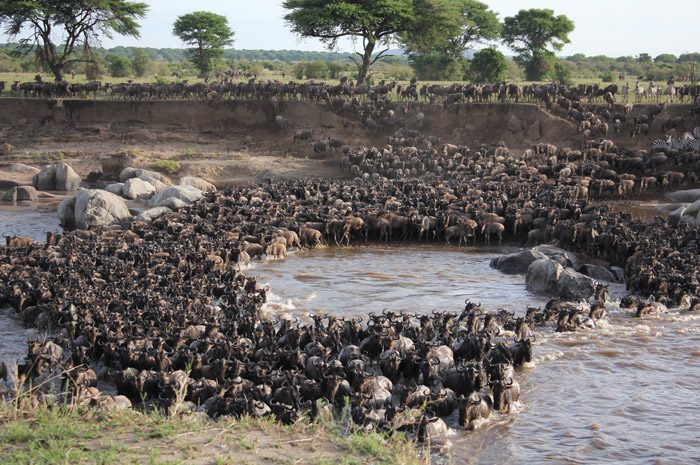
Huge savannahs and excellent grasslands that offer an abundance of grazing and hunting space for both grazers and predators are features shared by Kenya and Tanzania. The 270-degree horizon view offered by the Serengeti-Mara ecosystem makes it one of the easiest places in the world to see wildlife, including the well-known African Big Five (elephant, lion, buffalo, and leopard). The Annual Great Wildebeest Migration takes place in the Serengeti-Mara region every year. It involves two million wildebeest travelling in search of fresh pasture and water, with the assistance of a few hundred thousand antelope and zebra.
Tanzania is home to the world’s largest volcanic caldera, the Ngorongoro Crater, which is close to the Serengeti. Discover Africa’s highest peak, Mt. Kilimanjaro. Mt. Meru, another breathtaking summit in East Africa, is only southwest. Chimpanzee trekking enthusiasts can enjoy the Mahale Mountains National Park, one of Tanzania’s densely indigenous areas.
Other destinations to visit include
The nation’s effective capital, Dar es Salaam, is situated on the coast, as is Zanzibar. Other notable locations include Ruaha National Park, Nyerere National Park, Tarangire, Lake Manyara, Arusha National Park, Lake Tanganyika, Lake Victoria, and so forth.
The most well-known park in Kenya is Masai Mara, which provides a variety of animal and bird viewing opportunities. Beyond Masai Mara is Lake Nakuru, which is famous for the large numbers of flamingos that stand in its waters. Rare species like the ‘Samburu Special 5‘ (Beisa Oryx, reticulated giraffe, Somali ostrich, gerenuk (giraffe gazelle), and Grevy’s zebra) flourish in the drier, hillier north of Kenya, specifically in the Samburu region.
Conversely, there are numerous other notable locations such as Lake Naivasha, Tsavo National Park, Amboseli National Park, Mount Elgon, Mount Kenya, which is Africa’s second-highest peak. The capital of Kenya is Nairobi, which is also the location of Nairobi National Park. Mombasa, a coastal port city, offers a distinctive taste of Swahili culture. Additionally, it is the hub of stunning coastal resorts like Diani Beach.