
Incredible Elephant Facts to Know Before Your African Safari : Your dream has come true — you’ve booked an African safari. And now that the strategy is in place, you’d like to know a little bit more about the amazing creatures you’ll encounter along the way.
One of the animals that people most want to see on a safari is the African elephant. It is, in fact, one of the Big Five, the animals that big game hunters considered to be the hardest to pursue on foot. These days, safari tourists are the ones searching for this five-animal group, which also includes the cape buffalo, lion, rhinoceros, and leopard.
And those aren’t even the most amazing elephant facts that exist. These 11 fascinating facts will excite you for your journey into the wilderness.
1. They’re The Largest Land Mammal
On a safari, you can see the largest land mammal in the world if you happen to come across an African elephant. They surpass even Asian elephants in size.
An African elephant’s weight can reach 14,000 pounds, and its height can range from 8 to 13 feet. In contrast, Asian elephants can reach a height of 9.2 feet and a maximum weight of 11,000 pounds.
2. Their Closest Living Relative Isn’t What You’d Expect
The nearest living relative of the largest land mammal is unusually small. You have probably never heard of the small mammal known as the rock hyrax.
The small brown creature lives in the rocky regions of Arabian and Sub-Saharan Africa. It is genetically related to elephants because of the similarities in its toes, skull, and teeth.
3. You Can Differentiate Them By Their Ears
Assume you have a typical Asian elephant and a small African elephant side by side. How would you distinguish them?
As it happens, their ear shapes reveal them. Interestingly, the shape of an African elephant’s ears matches that of the continent. Asian elephants, meanwhile, have ears that closely resemble the shape of India.
4. They Carry Babies For A Very Long Time
Spotting an elephant, and maybe a baby, will be the main attraction of your Tanzanian safari. You should count yourself extremely fortunate if you spot a calf. Elephant mothers give birth to their offspring after carrying them for an astounding 22 months—the longest gestation period of any animal.
Furthermore, giving birth to an elephant calf is no easy task. Their babies weigh in at 250 pounds and are three feet tall at birth.
5. They’re Not Bug Lovers
An animal the size of an African elephant might seem to care less about bugs. True enough, they have no problem stepping on savannah floor-dwelling insects.
But when bugs get on their food, elephants do have an issue. The largest mammal in the world is a herbivore, meaning that its only food is plant matter such as leaves, twigs, fruit, grass, and bark.
However, they refuse to eat any herbivorous food if it contains ants. This is due to the large number of extremely sensitive nerve endings in their trunks. They stay away from meals covered in ants because it hurts if they get ants in there.
6. They Eat All Day Long — Quite Literally
Elephants don’t grow to be that big by coincidence. It turns out that they eat for anywhere between 12 and 18 hours every day.
And their trunks do most of the work while they chew. They use it to detect food, and then they use their trunks to seize the food they desire. It wouldn’t be attractive to pick up your dinner with your nose!
7. Peanuts? An Elephant Wouldn’t Dare
The best books on Africa tell you what to expect from the region, wildlife, and cultures while you’re there. However, a more widespread and false image of elephants has been perpetuated by popular culture. In particular, a myth exists regarding these enormous mammals and their fondness for peanuts.
It turns out that elephants never eat peanuts. In Africa, they are not to be found in the wild. Furthermore, zoos do not feed their animals legumes.
8. Elephants Believe In Girl Power
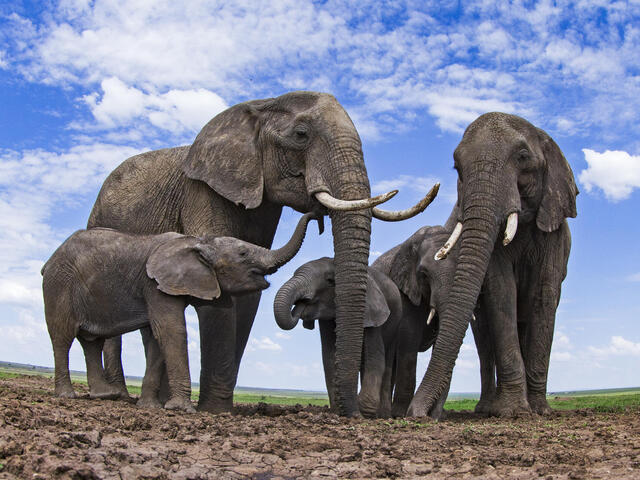
Maybe you’ll pass an elephant herd on your safari. Remember that you are most likely witnessing a group of females who have formed a bond as you watch them move across the savannah.
Elephant families are led by matriarchs, who are typically the oldest members of the herd. She is the leader of the group, deciding where they go and when to move during the day.
You’ll see her daughters with her, as well as theirs. Male elephants remain in the wild until they reach puberty, which typically occurs when they are 12 to 15 years old. At that point, they either go it alone or band together with a small male, despite the fact that they are considerably less cohesive than the female herds.
Elephants are not the only safari animals that experience this, if you have any knowledge of other wildlife. Lions also function in groups headed by females, with the males carrying out less duties.
9. Elephants Use Sunscreen
You must dress in protective clothing when going on a safari in order to keep yourself safe and comfortable. Elephants must protect themselves from the African sun just like everyone else.
However, their approaches to applying sunscreen will differ slightly from yours. Elephants cover their bodies with mud and sand to protect their skin from the sun’s rays. Pretty smart, huh?
10. Elephants Know Who They Are
For instance, you’ve undoubtedly seen amusing YouTube videos of puppies discovering their reflection for the first time. Frequently, they chase after themselves and bark, unaware that the dog they perceive is actually them.
Elephants, on the other hand, are able to identify themselves in the mirror because they have passed the mirror test. The same holds true for a select few creatures, such as great apes, dolphins, magpies, and young humans.
11. Elephants Say Hi To Each Other
How do you welcome those you love? With an embrace, maybe? Elephants follow suit.
They do not, of course, embrace one another in the same way that humans do. Rather, elephants hug their trunks to greet one another. With an embrace that only members of their species can provide, they entwine their noses around one another.
Elephant Facts — They’re Incredible
These facts about elephants have shown you that they are undoubtedly one of the most amazing animals in the world. You will eventually get the opportunity to see one while on an African safari.
Do you need more details to help you get ready for this once-in-a-lifetime experience? Follow our blog to get all the information you require.