
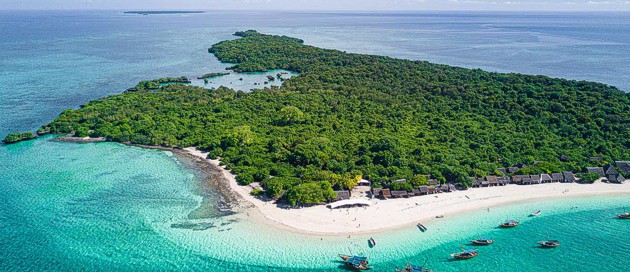
How To Visit Pemba Island, Tanzania : The Complete Guide : Pemba, which is a part of the Zanzibar Archipelago, is situated between Unguja Island, which is colloquially known as Zanzibar worldwide, and the Tanzania-Kenya border. The Green Island is how its Arabic name translates, which is a fitting name given its lush surroundings of heavily forested hills. The island’s hidden coves and white-sand beaches are separated from these hills, which are dotted with clove plantations, by a belt of thick mangrove forest, and the ocean itself is home to some of East Africa’s most pristine coral reefs.
It’s an off-the-beaten-path getaway for those who want to experience real island life in addition to world-class scuba diving and fishing because it has significantly fewer tourists and less tourist infrastructure than Zanzibar, which is nearby.
A HISTORY OF TRADE AND INVASION
Although the prehistory of Pemba is still obscure, it is most likely that its original inhabitants came from the continent of Africa several thousand years ago. The island became a significant stop on the Swahili Coast trade route as early as 600 AD. When traders from Arabia, India, and China stopped to stock up on spices, gold, ivory, and eventually slaves that were brought to the archipelago from the interior of the continent, they used its deep waters as a safe anchorage. Between the 11th and the 15th centuries, Pemba’s importance as a commercial hub peaked.
Portuguese colonists overran it at the start of the 16th century.
Portuguese rule persisted up until the 17th century, when Omani Arabs drove them out. Early in the 19th century, the Sultan of Muscat and Oman relocated his capital from Muscat to Stone Town on the neighboring island of Zanzibar. When the archipelago became a British protectorate in 1890, the Omani sultan continued to rule over Pemba and its sister islands. The protectorate was abolished in 1963, and a coup against the sultan that followed led to the establishment of the People’s Republic of Zanzibar and Pemba, which claimed thousands of lives. The republic united with Tanganyika’s main island in 1964 to form the United Republic of Tanzania.
THINGS TO DO AT PEMBA ISLAND
Scuba Diving and Fishing
Today, Pemba is best known as one of Africa’s best dive locations rather than as a commercial hub. The majority of the island’s dive sites are found off the west coast, where the land drops hundreds of meters into the deep waters of the Pemba Channel, despite the fact that the island is completely surrounded by coral reef. The underwater topography of the island, which is dominated by pinnacles and magnificent submarine walls, provides a natural habitat for a wide variety of marine life, including turtles, reef sharks, Napoleon wrasse, and large gamefish. Strong currents and great visibility are both characteristics of diving in Pemba, so it’s best for experienced divers. However, organizations like Swahili Divers provide courses for all levels of experience.
Deep-sea fishermen love the island because of its proximity to the Pemba Channel. You can choose from six different billfish species, including black, blue, and striped marlin, on a number of charters’ day trips and multi-day fishing safaris. The big-fighting giant trevally, dogtooth, and yellowfin tuna are just a few of the other well-known gamefish that are frequently discovered in the nutrient-rich waters of the channel.
Beaches and Wildlife
Pemba has fewer reachable beaches than Zanzibar because of its protective mangrove forests. Lodges and tour companies do, however, provide boat excursions to the coves that dot the island’s calmer east coast, where stretches of white or pink sand are uninhabited and gin-clear water washes them. The most well-known beach in Pemba is probably Vumawimbi. Its remote shores resemble a postcard from paradise come to life, and it is situated in the far northwest of the island on the Kigomasha Peninsula. Day trips are also offered to Misali Island, an uninhabited paradise off the central west coast of Pemba known for its stunning beaches, world-class diving, and shallow reefs ideal for snorkeling.
On dry land, nature lovers should go to the Kidike Flying Fox Sanctuary, which is home to about 4,000 endemic Pemba flying foxes. This enormous fruit bat, which has a wingspan of 5.3 feet (1.6 meters), is especially impressive when it soars above the forest canopy with hundreds of its roost mates. On the Ngezi Forest Reserve’s walking trails, you can also see flying foxes. Red colobus monkeys, vervet monkeys, and a variety of bird species, including the highly sought-after, endemic Pemba scops owl, are safe in this undeveloped area of indigenous forest. A local naturalist is required to accompany all walks within the reserve.
Cultural Attractions
Pemba’s vibrant culture can be experienced in a variety of ways. On a city tour of the capital, Chake-Chake, you can visit the old fort and slave port and discover how rural communities produce the goods they need to survive. Cloves are Pemba’s top export, and the island’s spice farms are home to more than 3.5 million clove trees. Visit the farms or the ZSTC Clove Oil Distillery to learn how the clove stems are transformed into essential oil.
Visit one of the numerous archeological sites that remain from Pemba’s heyday as a trade route if archaeology is your thing. Ras Mkumbuu’s ruins, which include a mosque, tombs, and homes from the 14th century, and Chwaka’s remains of the town of Haruni, which existed from the 11th to the 15th century, are the most extensive. The Mkama Ndume ruins, a 15th-century palace that had the distinction of being the only known fortification on the Swahili Coast, are arguably the most fascinating of all. Make sure to first stop at the Pemba Museum in Chake-Chake, where exhibits about the island’s history help put them in context, if you want to get the most out of your visit to any of these locations.
WHERE TO STAY
Due to its seclusion, Pemba is a natural choice for affluent tourists, and there are a few exquisite lodges to choose from. One of them is Constance Aiyana, whose 30 modern villas let the nearby ocean into your personal space. Additionally, the resort has a spa, an infinity pool, and a terrace restaurant. A private dive center and 18 tented safari-style bungalows, some with direct beach access and a plunge pool, are available at Fundu Lagoon. The Underwater Room at Manta Resort is the most extraordinary lodging option of all; it is a floating deck in the middle of the ocean with a submerged, glass-walled bedroom that overlooks the passing aquatic life.
If your budget doesn’t allow for such extravagance, the backpacker option, Lala Lodge, in the southern town of Mkoani, is a cozy option with positive traveler reviews.
HOW TO GET THERE
Flying into Pemba with a private aviation company like Coastal Aviation or Auric Air, both of which provide daily scheduled flights to Pemba Airport (PMA), close to Chake-Chake, is the simplest way to get there. Arusha, Dar es Salaam, and Zanzibar all offer flights to Pemba, with the latter taking only 30 minutes. Ferries can transport passengers between Pemba and Zanzibar, though their safety is debatable. The ferries run by Azam Marine are the most trustworthy. Use the local dala dalas or minibuses to get around if you choose to go exploring on your own after you arrive.
WHEN TO GO
Because Pemba is so close to the equator, the average annual temperature is a tropical 80 F (26.5 C), though it can get much hotter. The two rainy seasons are from April to May and November to December, respectively. Since the rains in April and May are so intense, many lodges close during this time. Generally speaking, the driest season (June to October) is the best time to travel. The humidity is at its lowest, the visibility is ideal for scuba diving, and there are fewer mosquitoes that carry malaria. However, anglers who want to catch a billfish should plan their trip for the months of September through March.