
Kilwa Ruins – World Heritage Site : In history, Kilwa was the African Kingdom. It had many great leaders in the past, from indigenous African Kings and queens to the Portuguese, Omani Sultan, and German colonials. The land had indigenous African traders or the Swahili. As traders, they collected gold, ivory, Rhino horns, leopard skins, and timber from inland Tanzania to exchange with other products brought by traders from the Asian continent. Kilwa is the best ancient city in Tanzania, now a District in the southern Lindi region of Tanzania. It is one of the seven world heritage sites located in east Africa.
The wealth of Kilwa
Kilwa’s source of wealth was clear gold, but it also transformed over time. These would have included ivory and enslaved people. But as time progressed, enslaved people made up a large percent of the trade and wealth of the city.
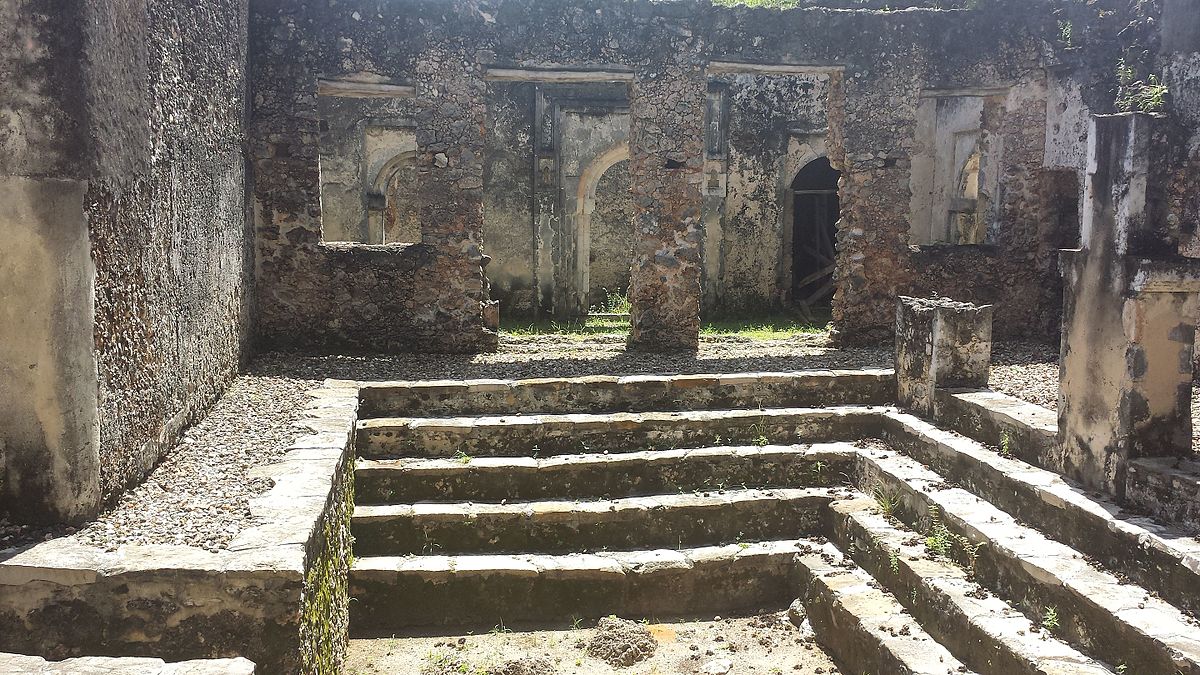
The remains of merchant traders’ wealth in Kilwa are in two small islands near the coast, Kilwa Kisiwani and Songo Mnara. Down below are the Kilwa Ruins.
THE GREAT PALACE OF KILWA
Sultan Al-Hassan bin Suleiman built the Great Palace. It consisted of two main areas, the public area and the private area. The large courtyard with many storerooms in the Public area was for trade goods. Also, there was an intermediary space that consisted of a sunken courtyard with a series of steep steps where people coming to see the Sultan would have sat and faced him. And then you get to the private part of the building, built around a bathing pool open to the view across the harbor, and the Sultan would have bathed inside this pool while watching the sunset over mainland Africa. The Great Palace is known as Husumi Kubwa in Swahili. It was the earliest surviving building on the coast of east Africa.
MAKUTANI PALACE
One of the earliest Swahili Sultans built The Makutani Palace (Omani Palace). But when the Omanis finally gained complete control over the Kilwa and the rest of the east African coasts, they expanded and greatly added the Makutani Palace by creating the structure seen today. The Makutani Palace consists of a building within a building. The palace is really at the center, and that would have been the residential area that sits within a much larger walled stockade used to store trade goods, but also most likely would have been used to imprison enslaved people they shipped north to Zanzibar.
THE GEREZA FORT
“Gereza” is a Swahili term meaning “prison” The Portuguese were the first to build The Gereza Fort in the 14th century, and Omani Arabs rebuilt it in the 19th century. It is a large square building made of coral stones, and the Northeast and Southwest of the fort had thick circular towers at corners. It has an impressive entrance with fine wood carving. Wind and sea have eaten powerful stones on one side of the building. Its courtyard has turned into grass, and high on its tower, some plants have taken root on it. The Gereza Fort has remained an attractive ruin on Kilwa Island, Kilwa Ruins – World Heritage Site.
A quick visit to Kilwa Kisiwani provides an exciting reminder as we discuss the rich history of the Swahili coast that stretches along the eastern Indian Ocean coast of Tanzania, which goes hand in hand with enjoying the scenic beauty of this island in the Kilwa district of the Lindi region, meanwhile the memories of past civilizations and early settlements can be a lifetime of memories for any visitor who ventures to this part of Tanzania. Kilwa Kisiwani, along with the twin islands of Songo Mnara, is a United Nations Scientific and Educational Organization (UNESCO) World Heritage Site, known for its rich history and Swahili cultural heritage that blends African cultures and those from Arabic societies. Kiliwa Kisiwani is a tourist attraction and one of the main and premier trading towns on the East African coast, famous for its historic buildings on the island that are constructed with a mixture of coral stone and limestone materials, which makes the building beautiful and stable to survive hundreds of years of humid and hot weather conditions. Between the thirteenth and the sixteenth centuries, the island prospered by controlling the Indian Ocean trade with Arabia, India and China, when gold and ivory from Tanzania mainland and the Congo were used for silver, carnelian, perfume, Persian earthenware and Chinese trade porcelain.
Upon review, you will have a wonderful experience visiting the ruins of Kilwa. There is a lot to be learned about Kilwa Town, it has a lot of history, and there is still much more to learn. Many travelers who visit Tanzania appreciate the southeastern region of Tanzania. It has a lot to offer, from amazing beaches on the coastal line to the greatest treasure of its people, welcoming and friend when you visit their town. Give the southern region a try when you come to Tanzania.