
African Elephants : Elephants being among the largest mammals living on land makes this unique specie to catch most of the wild animal lover’s attention. Elephants are found on various places on earth, and they are lucky to distribute almost on every continent, though it is uneven distribution. Despite elephants being found all over the globe, African elephants deserves a special mention. This is due to the easily observable features like size, up to the ones which needs a kin observation to explore the uniqueness of this African giants.
In terms of size, the male elephants usually have an average measurements of 3 meters high and the weighing of about up to six tones. Male elephants are said to be reaching their full size when they are almost at the age of thirty-five to forty years (35-40). This is about a half and some little addition of the total ages whereby their life expectancy especially for the wild elephants are said to be able to live for almost up to sixty and seventy years. This is not only just for the adults but also to the calves are also huge. The elephant calves are said to be weighing up to 120 kilograms to thrill while on Tanzania Safaris
Despite elephants being believed to be of different classes, we do have only two common elephant species. These two species are the Asian and the African species. The latter two classes or species of elephants can be differentiated in different ways. One of the common ways to differentiate them is by using their ears. The ears of the African elephants differ from the ears of Asian elephants in such a way that the ears of the African elephants are larger than the ears of the Asian ones. The former is also considered to be of the African continent in shape while the latter one is considered to be of the Asian or Indian continent in shape. Also, the ears of the African elephants are said to be of much larger size as compared to their cousins. There is also some sort of differences in their trunks. The trunks of the African elephants are of two fingers which are placed or found at the tip of their trunks while the Asian elephants have only one finger which is found at the tip of their trunks as well.
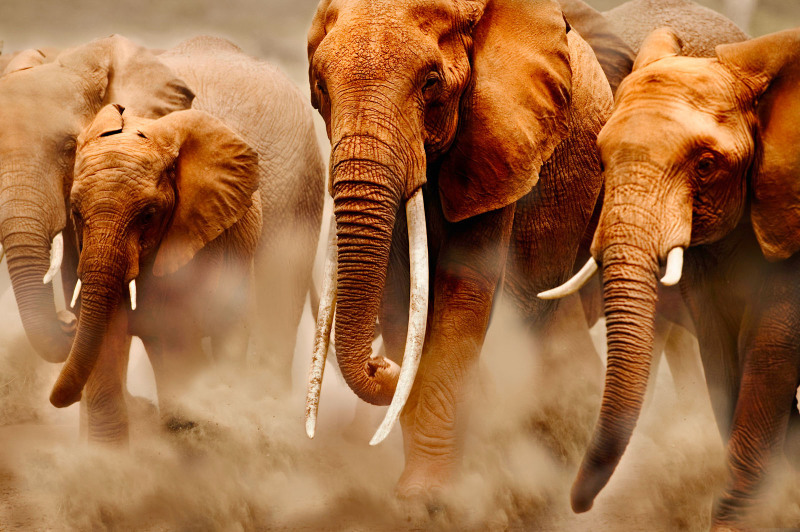
The trunks of the elephants are the most sensitive organs that are found in any other mammal; they are said to have more than 150,000 unit of muscles in the trunks of the elephants. There are various researches that proves how the powerfulness of the elephant trunks are. These researches have done especially to the Asian elephants that have been using their trunks in picking up some peanuts, shell them, blowing their shells off and eating the nuts. Again, elephants are said to be using their trunks in sucking up drinking water. These trunks have the ability to contain up to eight (8) liters of water. Elephants are also using their trunks for snorkeling when they are swimming in various water sources.
The tusks of the elephants are used as teeth as well; most of us identifies these teeth as tusks but in reality, they can function in a multiple manner. These tusks which are incisors in nature are starting to grow or appear among elephants’ calves when they are about two years of their age (2 years old). These tusks are continuing to grow in the entire lives of the elephants. These tusks are commonly for both classes; the African elephants as well as the Asian ones. As it has been said earlier before that these tusks play a multiple number of roles; they are firstly used in helping the elephants in feeding themselves. This is done when the tusks are used to prize off barks of the trees as well as digging their roots. The elephant tusks can also be used as a defensive mechanism when they are fighting among themselves or with any other mammal. Despite the fact that these tusks are of great importance to the elephants, they are said to cause a great danger as well. This is because a huge number of people are hunting and killing most of elephants and taking over their tusks. This is due to the fact that these tusks are made up of ivory which is considered one of the precious metals in the world. The ivory tusks are desired very much with the majority of people in the world.
Elephants possess a very thick skin; the elephants have got very thick skin as compared to most other animals in the world. The skin of the elephants is considered to be 2.5 centimeter thick to most of their body places. Their skins have the folds as well as the wrinkles which are capable of retaining water up to ten times than other body and skin parts does. These folds and wrinkles carry more water which are playing a crucial role in helping them to cool their body down especially during the hottest seasons of the year. They are also capable of keeping the skins of the elephants clean and are able to protect them from sunburning and other dangerous environments by taking dusts and the mud baths regularly. So, the thicky nature of the elephants is of significant importance to them. And this is very common to both; the African elephants as well as the Asian elephants. This thicky nature of the skin of the elephants is quite different from other large animals of the world. A part from them, even other animals in the big five cannot be found with such thick nature of their skins.
Elephants have the habit of eating constantly; elephants are spending much of their time eating. They are said to be able to eat almost about 150 kilograms of food per day. The large quantity of food taken among these elephants are said to be left undigested because they are taken in a very large amount at once. The 150 kilograms of food is equivalent to almost about 375 tins of the beans which are already baked, despite the fact that more than half of the food can leave the body while undigested. Elephants are said to be able to spend up to ¾ of their time in a day eating different foods. So, elephants have invested much of their time in searching for food to eat and water to drink.
Elephants are able to communicate by using the vibrations; elephants are said to have developed various ways of communications. Some of the ways used in communication are like the use of sounds that normally sounds like trumpet calls, though some of these sounds are too low to the extent that people cannot even be able to hear them. They are also using other ways of communications like the body languages, touching and scenting. Again, elephants can also communicate by using the seismic signals. Seismic signals include the sounds that are creating vibrations in the grounds. These sounds may be detected by the elephants through their bones. These ways of communications are quite different from the ways of communications that are used by other animals such as human being, dogs, lions, hyenas, leopards and cows. Every mammal; regardless of their body size have their own way of communications. These ways differ from one animal to another and they are of different manner. For instance, human being communicates the use of arbitrary vocal symbols which appear to have meaning in one or another sense. This is quite different from other world creatures since human being are the only mammals that use language for communications.

The elephant calves become able to stand almost about twenty minutes after their birth; this is so amazing and interesting. The elephant calves may become able to stand only within twenty minutes after being born. Again, they are said to be able to walk about an hour after their birth. The elephant calves can become part and parcels of their herds after only two days of their birth. This is actually the incredible survival tactic that enable elephants to keep moving and migrating with the herds in the journey of finding water and food for the sake of surviving.
One of elephants interesting history is that they ever keep their memories in touch; the elephants never ever able to forget. They have the large temporal lobe. This temporal lobe is the part of the brain that is concerned with the issues related to memory and forgetting. The temporal lobe of the elephants is large and denser than that of any other animal or mammals. Their memory ability is large even more than that of human being. This is what produces the saying that elephants do not forget ever.
Almost about ninety percent of the elephants that are found in Africa have been swept away in the past century; African elephants are under threat more as compared to any other species. It is statistically believed that more than ninety percent of the African elephants have been hunted down due to the fact their tusks are of great value in ivory trading circles. This statistics count for the past one century in Africa leaving most of the elephants’ dead entities. It is estimated that only 415,000 elephants are living today especially the wildlife. Apart from African elephants, Asian elephants are also under threat as well. They are believed to be declined for almost about half percent in the last three generations respectively. And the total number of the Asian elephants today is said to be almost about 45,000 only living in the wild. Most of the elephants lose their lives when the wild experience climatic and habitual changes leading to their movement and migration from one place to another. During their movement they tend to find themselves into people’s settlements and tend to be hunted out. They are normally coming into contact with the dangerous people when migrating looking for water to drink and food to feed themselves.
The elephants are the only mammals that have no ability to jump; despite of their differences in species, sizes and ages; elephants cannot jump at all. This is just because of their body weight which is huge as compared to any other mammals whether a wild or a domestic one. Their eating habit also do not support at all them to jump. They eat large quantity of food and drink large amount of water. Elephants will never be able to jump at all.
Elephants are the national animals of Thailand. Thailand recognizes elephants as their national animals. This is because they are many in number and easily accessible. They are also valuable to the national income through tourism activities.