
Amazing facts about the wildebeest migration
Amazing facts about the wildebeest migration : The wildebeest migration is one of the world’s amazing spectacles which take place in the Serengeti-Mara ecosystem. Some of the facts about this migration include the following;
- Natural wonder of Tanzania
The wildebeest migration is among the natural wonders of Tanzania and is considered the largest migration of wildlife. This migration also takes place in the south western part of Kenya in the Masai Mara national reserve.
Other natural wonders of Tanzania include Mount Kilimanjaro which is the highest mountain in Africa at 5895 meters, the Ngorongoro crater, Serengeti national park, Tarangire national park, Selous game reserve among others.
- Movement in herds
During the wildebeest migration, wildebeests can be seen in their herds as they graze across the savannah plains of Serengeti national park. Over 1.5 million wildebeests can be spotted grazing during the wildebeest migration.
Zebras and gazelles also move along with the wildebeest herds during the wildebeest migration. The relationship between the wildebeests and the zebras during the wildebeest migration is that the zebras feed on the longer grass while the wildebeests feed on short grass.
Predators such as lions, hyenas, cheetahs among others can also be seen during the wildebeest migration as they hunt and prey on the wildebeests.
Wildebeests are also known to be ever moving and tend to graze both in the night and also during the day. However, not all the wildebeests migrate and some stay behind as resident herds.
- Also known as gnu
Wildebeests are also referred to as gnu and herbivores in nature as they feed on the savannah plains. Tourists from different parts of the world engage in safaris to see these wildebeests as they migrate in search of greener pastures and water.
In appearance, wildebeests are similar to cattle and some of the characteristics they have include a dark grey color, horns, a distinctive muzzle, a rectangular head shape and white beards. The type of wildebeests which migrate around Kenya and Tanzania are the blue wildebeests. Another type of wildebeests is the black wildebeests.
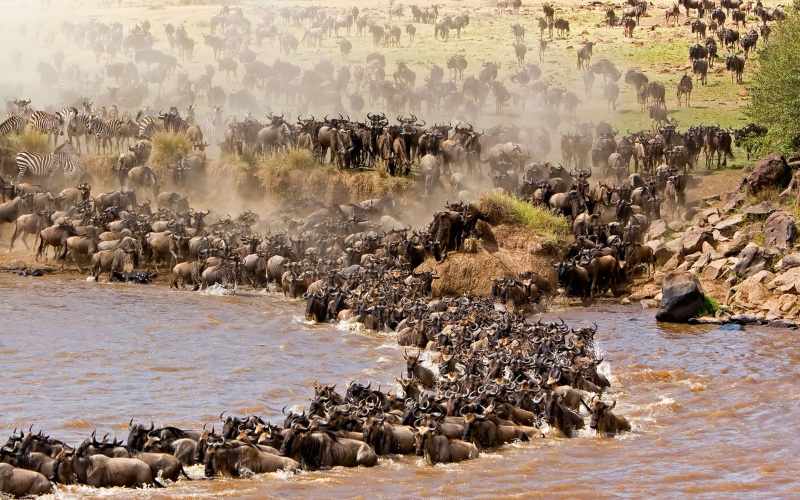
Wildebeests are also considered to be large antelopes and are among the many wildlife species seen in Serengeti national park in the northern part of Tanzania and also in Kenya.
- Annual migration
The wildebeest migration takes place annually and can be seen across the Serengeti-Mara ecosystem at different times of the year. Some of the highlights during this migration include the river crossings across Grumeti and Mara river around June and July.
Another highlight of the annual wildebeest migration is the calving season when young calves are born in the grassy plains around southern Serengeti and the Ngorongoro conservation area. The calving season happens from December to March when about 8000 calves are born daily.
The wildebeest migration also takes place across other parts of Serengeti national park such as the western Serengeti, central Serengeti and the southern plains. This movement of the wildebeests is a circular motion and also this movement follows the rains.
- Strong calves
When the calves of the wildebeests are born, they take a short while and can be seen running around the grassy plains after being born. This is referred to as the calving season when about 8000 wildebeests are born daily during the months of December to March.
The calving season during the wildebeest migration also takes place around the Ndutu area, the southern Serengeti plains and around the Ngorongoro conservation area.
The wildebeests give birth to their calves within their herds in the grassy plains which makes it easier to see predators like lions, cheetahs and hyenas which are known to attack the young wildebeests.
The gestation period for the wildebeests is about 9 months and the period when wildebeests give birth to their calves takes about 2 to 3 weeks.