
The 13 Primates of Kibale National Park
The 13 Primates of Kibale National Park: Kibale national park is one of the richest ecological systems in Africa as it is one of the few areas where montane and lowland forests meet, the park is dominantly forested covering an area of 795 square kilometers and it is a prominent home for primates thus making it perfect for chimpanzee tracking and chimpanzee habituation experience.
Kibale national park is a home to 13 species of primates and these species are as explained and listed below
Chimpanzees
Among the primates in kibale national park, chimpanzees have the largest population and because the huge numbers kibale national park has become famous and a renown home for a largest population of chimpanzees in Uganda and East Africa. Kibale national park being a forest dominated national park consisting of rainforest trees and woodland savannah, it has become an excellent habitant for chimpanzees to thrive peacefully. Chimpanzee in the forests of kibale have been recorded to be over 1000 individuals and among this huge population only 80 of them have been habituated for chimpanzee tracking and chimpanzee habituation experience. Chimpanzees are closely related to human beings as they share 98.7% of their DNA and with humans and the resemblance is manifested in their laughters, way of walking as they can walk on 2 legs and hugs. Among all the primates in kibale national park chimpanzees have been recognized to be the most intelligent of them all, their intelligence is seen in their ability to adapt to the usage of tools such as trees to dig for insects and branches of trees to act as umbrella incase of rain situations.

Physically chimpanzees are fully covered in coarse black hair all over their body with an exceptional of their bare face, fingers, toes, palms of their hands and soles of their feet, chimpanzees are relatively larger with males weighing 40-70 kilograms and female weighing 27-50 and they stand at a height of 3.3 – 4.9 ft in height.
Red-tailed Monkeys
Red tailed monkeys are another kind of primates living and thriving in the green forests of kibale national park, red tailed monkeys are also referred to as spot – nosed monkey, red tailed guenon or a black-cheeked-white-nosed monkey. Like their name red tailed monkeys feature red coloration on their tail which increases from the base to the tip, they also feature white nose and cheeks a midst of black or grey body fur. The most outstanding feature on the red – tailed monkeys is the very large elastic cheeks which they use in gathering and storing their food such as insects, leaves, flowers and fruits. In size red –tailed monkeys’ bodies range in individuals as well as sexes, adult males weigh between 7- 10 pounds and females weigh between 6 – 8 pounds. These monkeys use their 35 inches long tail to achieve their balance while walking and swinging on trees.

Black And White Colobus Monkeys
Black and white colobus monkeys also referred to as colobi are closely related red colobus monkeys living in the forests of kibale national park, black and white colobus monkeys are territorial primates living in groups of 3-15 individuals and the groups have been recognized to consist of one male and 8 females. Physically these monkeys are born with white fur and pink face and as they grow they get a full black fur covering the body and white beard that is why they are referred to as black and white colobus monkeys.
Like other primates black and white colobus monkeys fed on leaves, fruits, insects and roots
L’Hoest Monkeys
L’Hoest Monkeys are dark coat primates with white beard, these animals are found of living in mountainous forested areas which make kibale national park a favorite home for them in Uganda. L’Hoest Monkeys are physically short, covered with dark brown coat and chestnut color across the back and a dark belly. The most noticed feature on the these monkeys are the large cheeks with are light gray with a pale moustache and a long tail which is hook-shaped at the end, L’Hoest Monkeys have a body length of 12.5 – 27 inches and a tail length of 19 – 39 inches. L’Hoest Monkeys body weight depends on the sex of the monkey, male L’Hoest Monkeys weigh about 6 kilograms and females weighing about 3.5 kilograms.
Vervet Monkeys
Vervet monkeys are also other beautiful primates living in the forests of kibale national park which is a perfect home for many species of primates in Uganda, vervet monkeys share same resemblance with gray langur and physically they have black face with a whit fringe of hair (their overall body of the monkeys is mostly grizzled grey). Vervet monkeys are social primates living in groups which feature dominance hierarchies, when a male vervet monkey reaches sexual maturity they move to the neighboring group and then often move with a brother or their peer for protection against aggression by males and females in a resident group. Male hierarchies are determined by age, fighting abilities, allies and tenure in a group. Female vervet monkeys remain in their resident groups throughout their life and their hierarchies are determined by on the maternal social status.

Physically vervet monkeys weight and body length depends on the sex of the individual, adult females weigh between 3.9 – 8 kg and their body length is between 420 mm- 600 mm from the top of the head to the base of the tail. Adult female weigh between 3.4 – 5.3 kg and their body length is between 300 – 495 mm.
Olive Baboons
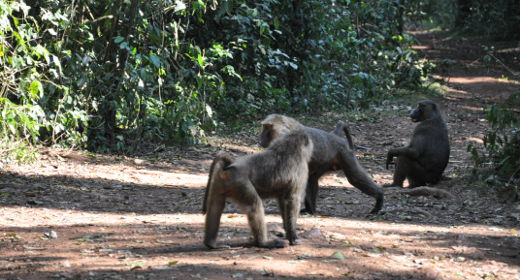
Olive baboons are another species of primates living in kibale national park, olive baboons are also referred to as Anubis baboons and their name is derived from its coat’s color which is a shade of grey. Olive baboons are one of the largest species in monkeys and their physical appearance that is body size and length depends on the sex, males are of 70 cm tall and weigh the average of 24 kilograms, females stand at a height of 60 cm in height and they weigh an average of 1.4 kilograms. Olive baboons have elongated, dog like muzzle and a tail of 38 – 58 cm, this tail almost looks as if it is broken and it erects for the first quarter as it drops down sharply. Olive baboons live in big groups and they are easily seen along the road side as you head to kibale national park, this sight is entertaining and at the same time frightening because they look like dogs but you cannot miss to take a beautiful picture.
Blue Monkeys
Blue monkeys are part of only 20 species of guenon monkeys and there are only 3 of these species in Uganda, blue monkeys’ name is derived from the dark – blue – grey color coat covering their body. Blue monkeys are not really blue but they have little hair on its face which gives it a blue appearance, they also have distinct patches of white fur on the chest and white throat. Blue monkeys are social monkeys living in groups of 4 – 12 monkeys and it is easy to spot them in the forests of kibale national park.
Grey Cheeked Mangabeys
Grey cheeked mangabeys are also one of the 13 species of primates living in the forests of kibale national park, the mangabeys are also referred to as white – cheeked mangabey. Grey checked mangabeys are dark monkeys in a resemblance of a small hairy baboon, in appearance they are covered with thick brown fur which is so close to being black. These monkeys are easily spotted in kibale national park, currently they are undergoing habituation process to be opened for tracking like the chimpanzees.

Uganda Red Colobus
These beautiful monkeys are easily seen playing on the forest trees of kibale national park, in appearance Uganda red colobus have a rust-red cap with a dark grey to black face. Infant Uganda red colobus are born different in appearance as they are born with completely black fences, the coloration of these monkeys ranges from black to grey through a reddish brown. Uganda red colobus have very long feet and tails which help them balance on trees as they climb and leap on the trees of kibale national park.
Demidoff Galago
Demidoff Galago are commonly known as bush babies and Prince Demidoff’s bush baby and they are among the primates living in the forests of kibale national park, these primates are one of the smallest primates and are easily spotted in the night. Demidoff Galago have large eyes which is the most attractive feature on them, these eyes help them see at night. These primates also have an acute sense of hearing and long tails which help them balance on trees of kibale national park, bush baby are easily seen during night forest walks in the park.
The Pottos
The pottos are another small primates living in the forests of kibale national park, these primates have an average length of 14 inches and weight of 1.8 – 3.5 pounds, and pottos have a resemblance to Demidoff Galago which they share with their big eyes. Pottos are arboreal animal which dictate their nature of spending more time in the trees, these primates’ hands help them get a strong grip and grasp on tree branches. Pottos are born with a white shade of color and as they grow they turn into grey, reddish or brown color.
Patas monkeys
Patas monkeys are also known as military monkeys which a depiction of their red fur and soldier- like moustache, the patas are noticeably the fastest primate among the primates in the world and they have the capacity to run 35 meters per hour most especially in times of danger. Patas monkeys live in troops which are led by female patas, the purpose of the males in the group is to breed and send alarm in times of danger.
Uganda Mangabey
Uganda Mangabeys are endemic species to Uganda, these primates shared much resemblance with the grey – cheeked mangabeys and for a long time they were mistaken to be them until 2007 when they were recognized as their own species.
Besides kibale forest national park, the primates can also be found across east africa ie in Rwanda at Nyungwe forest national park, Tanzania at Mahale mountains National park and Gombe stream National park.